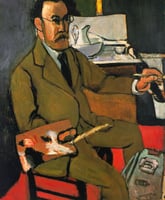
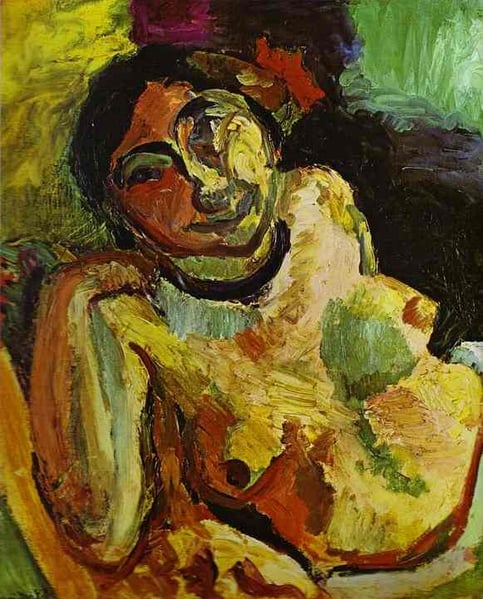
Expert analysis of Henri Matisse’s Gypsy
Style: Fauvism · Genre: nude painting (nu)
"Gypsy" by Henri Matisse stands as a vivid exemplar of Fauvist innovation within the traditional genre of the nude (nu). Executed during the height of the Fauvist movement (c. 1905–1907), this work boldly rejects naturalistic representation in favor of expressive, arbitrary color and vigorous brushwork. The nude figure—a perennial subject in Western art—is liberated from academic ideals of proportion and modeling. Instead, Matisse's palette employs clashing, non-descriptive hues (e.g., green or blue flesh, orange contours) to convey emotional intensity and the sensory pleasure of pure paint. This approach disrupts the viewer's expectation of a passive, idealized nude, presenting instead a raw, almost primitivized presence that aligns with Fauvism's debt to Post-Impressionism and non-Western art. The painting's significance lies in its radical redefinition of the nude: not as a mimetic form, but as a vehicle for chromatic harmony and pictorial structure, foreshadowing Matisse's later, more distilled works. "Gypsy" thus epitomizes how Fauvism injected modernist vigor—through jarring color and expressive distortion—into even the most classical of genres.
Visually similar
20 works with related composition and palette
Délfrancia Táj
Bela Czobel
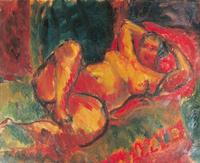
Reclining Red Nude I
Matthew Smith
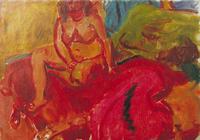
Seated Nude
Matthew Smith
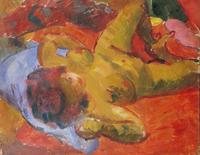
Nude with a Blue Pillow
Matthew Smith
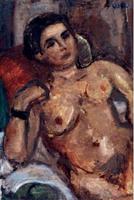
Czóbel Fiatal ,lány Akt
Bela Czobel
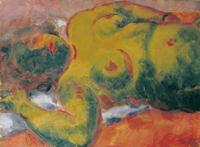
Reclining Nude
Matthew Smith
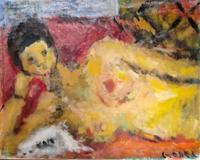
Félakt
Bela Czobel
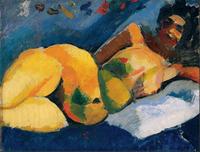
Berény Róbert , Fekvő Akt 1907
Berény Róbert
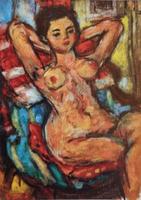
Ülő Nő
Bela Czobel
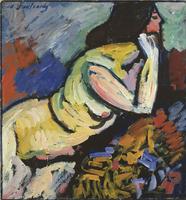
Nude
Alexej von Jawlensky
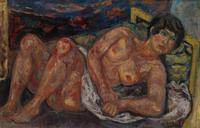
Reclining Nude
Pinchus Kremegne
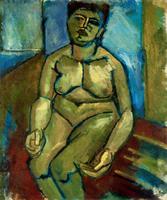
Seated nude
Raoul Dufy
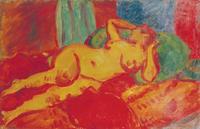
Large Reclining Nude III
Matthew Smith
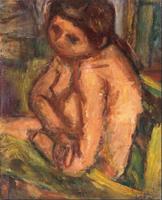
Czobel Béla Half Nude
Bela Czobel
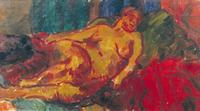
Reclining Nude
Matthew Smith
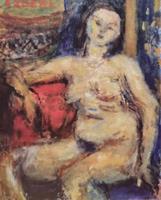
Seated Nude
Bela Czobel
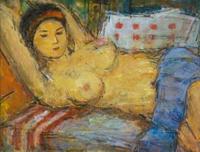
Czobel Bela Fekvő Akt
Bela Czobel
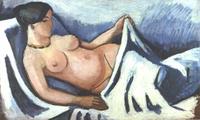
Reclining female nude
August Macke
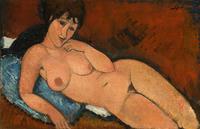
Nude on a Blue Cushion
Amedeo Modigliani
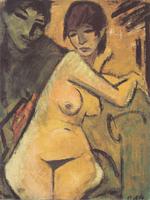
Liebespaar
Otto Mueller