Analisi esperta di Polynesia, La Mer di Henri Matisse
Stile: Abstract Expressionism · Genere: figurative
Analysis of Polynesia, La Mer by Henri Matisse
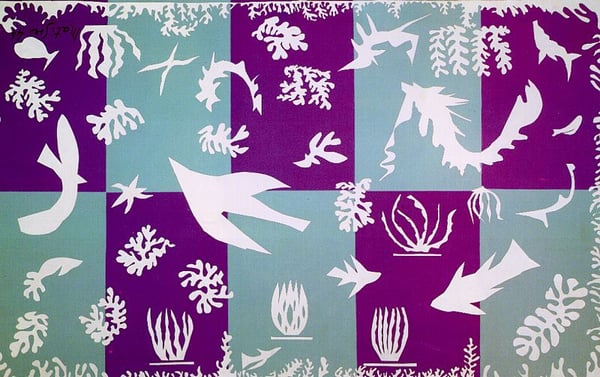
Although Polynesia, La Mer (1946) is often associated with Matisse’s late cut-out technique, the provided facts classify it within Abstract Expressionism and as a figurative work. Within this framework, the painting is significant for its bold push toward non-representational yet deeply humanistic expression, serving as a bridge between European modernist figuration and the emotional intensity of Abstract Expressionism.
Figurative Abstraction and Expressive Form
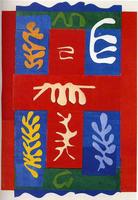
Despite its abstracted shapes—suggestive of marine life, leaves, and water—the work remains firmly figurative, evoking the lush, organic world of Polynesia. Matisse distills natural forms into simplified, flowing silhouettes, retaining their essence while stripping away detail. This approach prefigures Abstract Expressionism’s emphasis on raw, gestural marks that convey feeling over literal depiction.
Color as Emotional Force
The palette of deep blues, bright yellows, and bold whites is not merely decorative but expressive, echoing the Abstract Expressionist belief that color itself carries psychological weight. Large, flat fields of blue and white create a sense of oceanic depth and rhythmic motion, while the yellow elements—likely fish or birds—pulse with life. This chromatic intensity, combined with the organic shapes, generates a visceral response, aligning with the movement’s goal of direct emotional communication.
Significance Within Period and Style
Matisse’s Polynesia, La Mer is significant because it demonstrates how figurative reference points could be used to achieve the same expressive autonomy sought by Abstract Expressionists. The work’s flattened space, lack of traditional perspective, and emphasis on all-over composition anticipate the “all-over” field paintings of Jackson Pollock and Mark Rothko. Yet Matisse anchors his abstraction in recognizable nature, proving that figurative roots need not limit emotional intensity.
In the context of Abstract Expressionism, this piece stands as a European precursor that influenced American painters exploring the balance between representation and pure abstraction. It remains a testament to Matisse’s ability to transform observed reality into a universal language of feeling—a core ambition of the movement.
Museum / Gallery
Visivamente simili
20 opere con composizione e palette affini
Polynesia, the sky
Henri Matisse
sem titulo
Sa Nogueira
The album "Circus"
Fernand Leger
The album "Circus"
Fernand Leger
Sky and Water II
M.C. Escher
Predestination
M.C. Escher
Two Intersecting Planes
M.C. Escher
Untitled from The Test of the Title (Le Test du titre)
Pierre Alechinsky
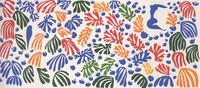
La Perruche et la Sirene
Henri Matisse
Plane Filling Motif with Birds
M.C. Escher
Anfitrite
Henri Matisse
The album "Circus"
Fernand Leger
Dream 2034 Trip in the Space Coordinates 2333 X 5755 Y 989 Z of My Pineal Gland
Carloluigi Colombo
Golden Fishes in the Dark Sea
Twins Seven Seven
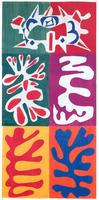
Panel with Mask
Henri Matisse
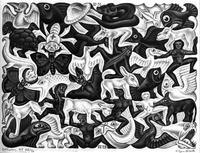
Mosaic I
M.C. Escher
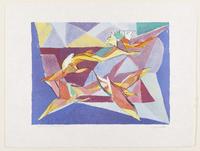
Birds in Flight
Jacques Villon
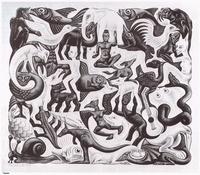
Mosaic II
M.C. Escher
Cut Outs
Henri Matisse
Sun and Moon
M.C. Escher