Expert analysis of Henri Matisse’s Still Life after de Heem's 'La Desserte'
Style: Cubism · Genre: still life
Expert Analysis: "Still Life after de Heem's 'La Desserte'" by Henri Matisse
Style: Cubism | Genre: Still Life
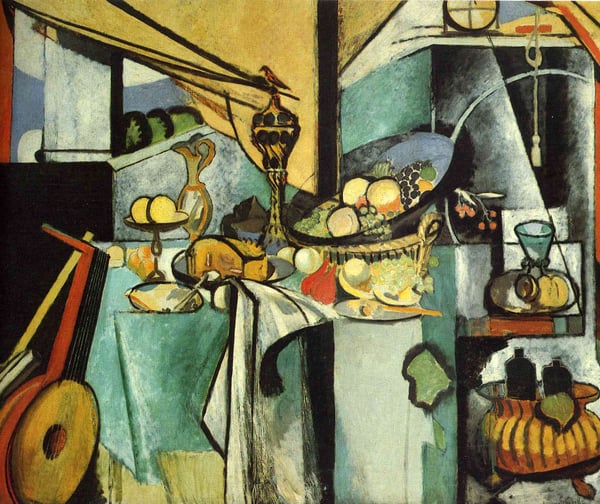
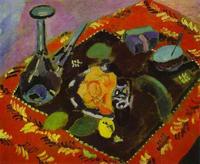
This work holds a singular place in the history of Cubism and Matisse’s oeuvre. It is significant not only as a masterful still life but as a direct, deliberate dialogue between the avant-garde and the old masters. By explicitly referencing Jan Davidsz de Heem’s 17th-century Dutch Baroque still life La Desserte, Matisse superimposes Cubism’s revolutionary visual language onto a tradition of meticulous naturalism, creating a tension that defines the work’s importance.
Within the Cubist genre, the painting demonstrates a synthetic integration of multiple perspectives and fractured planes—hallmarks of the movement—but with Matisse’s distinctive chromatic sensibility. Rather than the monochromatic, analytic approach of early Cubism (as seen in Picasso or Braque), Matisse retains a heightened sense of pattern and decorative rhythm. The tabletop, fruit, and drapery are deconstructed into angular, overlapping facets, yet warm reds, ochres, and greens persist, challenging Cubism’s typical austerity.
The significance lies in this act of reinterpretation: Matisse proves that Cubism is not merely a rupture with the past but a lens through which tradition can be re-examined. By reworking a still life by de Heem—a master of luxurious surface and illusionistic depth—Matisse foregrounds the Cubist concern with pictorial flatness and the autonomy of the picture plane. The composition becomes a meditation on representation itself: what is “seen” in the original is broken apart and reassembled according to geometric logic, while still alluding to the sumptuousness of the Dutch original. This work thus exemplifies Cubism’s capacity to absorb and transform art history, while also revealing Matisse’s unique contribution to the movement—a fusion of structural rigor with his own innate decorative elegance.
Genre
Style
Visually similar
20 works with related composition and palette
Vase, Bottle and Fruit
Henri Matisse
Still Life with Vase, Bottle and Fruit
Henri Matisse
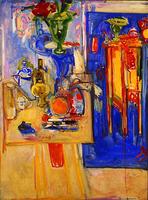
Table with Teakettle, Green Vase and Red Flowers
Hans Hofmann
Czóbel Beéa 1930
Bela Czobel
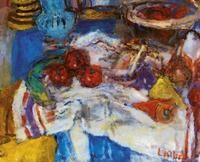
Czobel Béla Csendélet
Bela Czobel
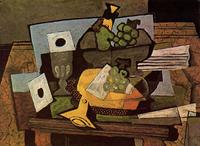
Still life (with clarinet)
Georges Braque
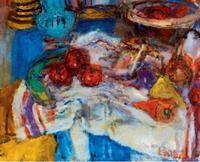
Czóbel Béla ,csendélet
Bela Czobel
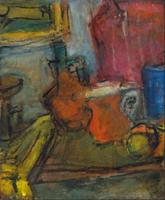
Czóbel Csendélet Vázákkal
Bela Czobel
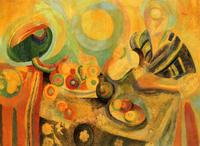
Pouring
Robert Delaunay
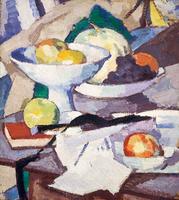
Still Life with Melon
Samuel Peploe
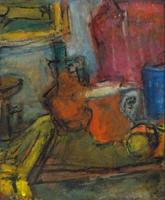
Czobel Bela Csendélet Vázákkal Festménnyel
Bela Czobel
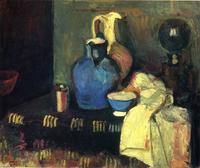
Blue Pitcher
Henri Matisse
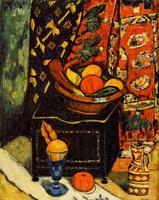
Still Life, No. 1
Marsden Hartley
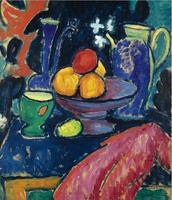
Still-life with jug
Alexej von Jawlensky
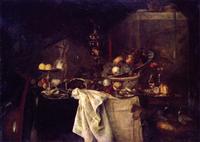
La Deserte (after Jan Davidsz, De Heem)
Henri Matisse
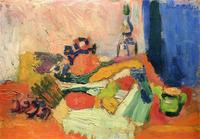
Untitled
Henri Matisse
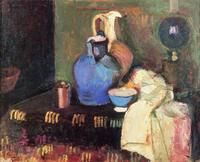
The Blue Jug
Henri Matisse
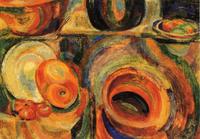
Portugese Still Life
Sonia Delaunay
Dishes and Fruit
Henri Matisse
Nature morte
Jean Metzinger