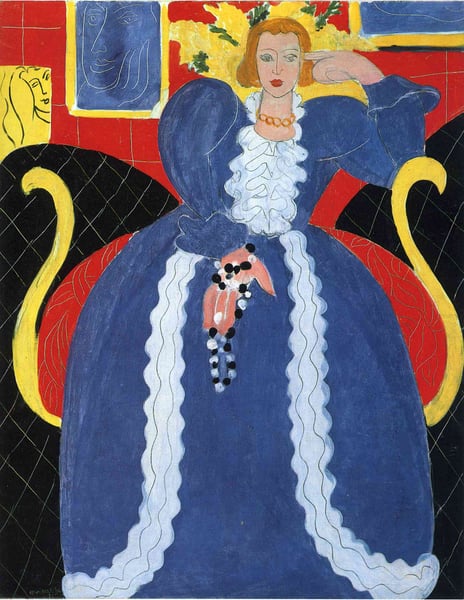
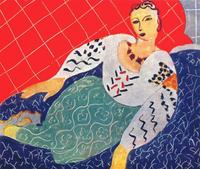
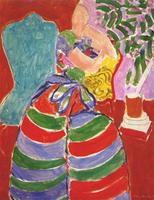
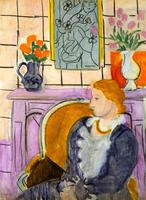
Henri Matisse’s Woman in Blue, or The Large Blue Robe and Mimosas is a significant example of Expressionist portraiture. As an Expressionist work, it prioritizes emotional and psychological resonance over naturalistic likeness. The bold, dominant blue of the robe — emphasized in the alternate title — is not merely descriptive but symbolic, conveying a sense of calm, depth, or melancholy typical of the movement’s subjective use of color. The inclusion of “mimosas” suggests a contrast in color (yellow against blue) and texture, a hallmark of Matisse’s expressive, decorative approach. This painting is significant because it demonstrates how Expressionist portraiture can transform the human figure into a vehicle for mood and formal exploration, flattening space and simplifying form to evoke inner life. Within Matisse’s broader career, it exemplifies his post-Fauvist commitment to vibrant, non-naturalistic color and pattern, aligning perfectly with the genre’s aim to express emotion through distortion and harmony.