Sir Lawrence Alma-Tadema sanatçısının A woman kneeling next to a sarcophagus and crying eseri hakkında uzman analizi
Tarz: Romanticism · Tür: genre painting
Expert Analysis: A Woman Kneeling Next to a Sarcophagus and Crying by Sir Lawrence Alma-Tadema
Style: Romanticism
Genre: Genre painting
Significance Within Romanticism and Genre Painting
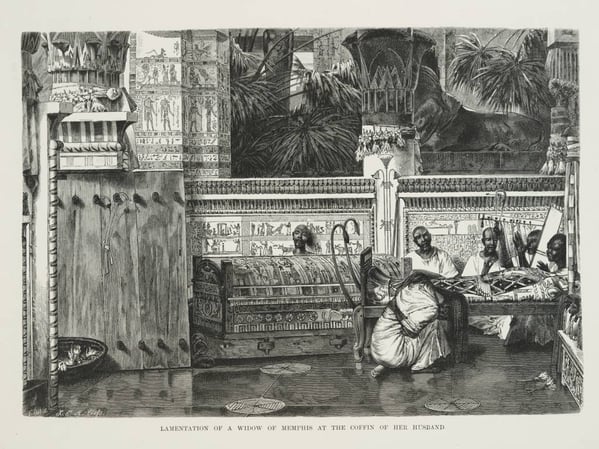
At first glance, Alma-Tadema’s work may seem an outlier within Romanticism—a movement usually defined by dramatic landscapes, sublime nature, and intense emotional subjectivity. Yet this painting exemplifies a lesser‑explored vein of Romanticism: the evocation of personal grief set against the grandeur of antiquity. By focusing on a single, unnamed woman’s private sorrow rather than a heroic or mythological event, Alma‑Tadema transforms the ancient sarcophagus from a grand historical relic into a deeply human monument of loss.
1. Emotional Intensity and the Romantic Sublime
Romanticism prized the expression of powerful emotions—awe, terror, melancholy. Here, the kneeling woman’s hunched posture, the weight of her head in her hands, and the visible tears convey a raw, almost palpable grief. The contrast between her fragile, living form and the cold, durable marble of the sarcophagus heightens the Romantic tension between transience and eternity. Her sorrow is not idealized; it is intimate and visceral, aligning with Romanticism’s turn toward the inner self and individual feeling.
2. Historicism and the Romantic Fascination with the Past
Alma‑Tadema was renowned for his archaeological precision—the sarcophagus’s carved reliefs, the texture of the stone, the folds of the woman’s drapery are rendered with near‑photographic accuracy. For Romantic artists, the past was a source of mystery and emotional resonance. By placing a contemporary (or timeless) human figure in an exquisitely reconstructed ancient setting, the artist creates a bridge between the viewer’s own emotions and the “lost” world of antiquity. This fusion of meticulous detail with poignant human drama was a signature of Alma‑Tadema and a hallmark of later Romantic historicism.
3. Genre Painting Elevated to Psychological Drama
Traditionally, genre painting depicted everyday life, often with moral or sentimental narratives. Here, the genre scene becomes a vehicle for Romantic introspection. There is no clear story—no name, no context—only the universal act of mourning. This ambiguity invites the viewer to project their own experiences of loss onto the painting, making the work deeply personal. The woman’s isolation within the frame emphasizes her solitude, turning a simple genre subject into a study of psychological depth.
4. Contrasts of Light, Texture, and Mood
Romanticism often employed dramatic chiaroscuro to heighten emotion. Alma‑Tadema likely uses soft, diffused light to illuminate the woman’s face and hands while leaving the sarcophagus’s shadows heavy and foreboding. The polished marble’s coolness contrasts with the warmth of her skin and the fabric’s folds, underscoring the tension between the living and the dead. The overall mood is one of quiet, dignified despair rather than theatrical grief—a more nuanced Romantic sentiment.
Conclusion
This painting is significant because it marries the Romantic obsession with emotional truth and historical imagination to the precision of a genre scene. Alma‑Tadema proves that Romanticism could flourish not only in stormy landscapes or revolutionary allegories but also in the silent, tear‑filled space between a woman and a stone tomb. The work challenges the viewer to see antiquity not as a remote, cold museum piece but as a mirror for the most human of emotions—grief, memory, and love that endures beyond death. In doing so, it stands as a powerful, understated masterpiece of Romantic genre painting.
Görsel olarak benzer
İlişkili kompozisyon ve renk paletine sahip 20 eser
The Egyptian Widow
Sir Lawrence Alma-Tadema
Pharaoh asked Moses to bring jewish people out of Egypt
Alexander Ivanov
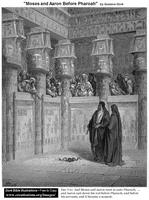
Moses and Aaron Before Pharaoh
Gustave Dore
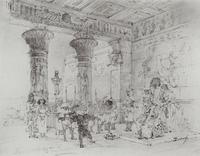
Pharaoh's Palace
Vasily Polenov
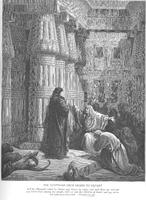
The Egyptians Ask Moses to Depart
Gustave Dore
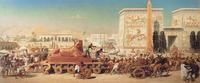
Israel in Egypt
Edward Poynter
A man dressed in white robes and a thick belt, leaning against a pillar
Sir Lawrence Alma-Tadema
Joseph Interprets Pharaoh's Dream
James Tissot
Portico of the Temple of Isis at Philae
David Roberts
The Sultana Chegger-Eddour and the Emir Saif-Eddin
Gustave Dore
Christian Cavaliers Captive at Cairo
Gustave Dore
Joseph Dwelleth in Egypt
James Tissot
Depiction of Joseph reading to the Pharaoh
Sir Lawrence Alma-Tadema
Cleopatra
Red Grooms
The Plague of Flies
James Tissot
The Death of Cleopatra
Juan Luna
Cleopatra Testing Poisons on Those Condemned to Death
Alexandre Cabanel
The Fortune Teller's Tale
Anatolio Scifoni
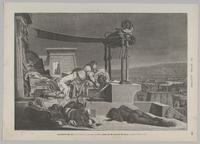
The Bearer of Bad Tidings (from Le Monde Illustré)
Jean Lecomte du Nouÿ
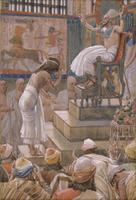
Joseph and His Brethren Welcomed by Pharaoh
James Tissot