
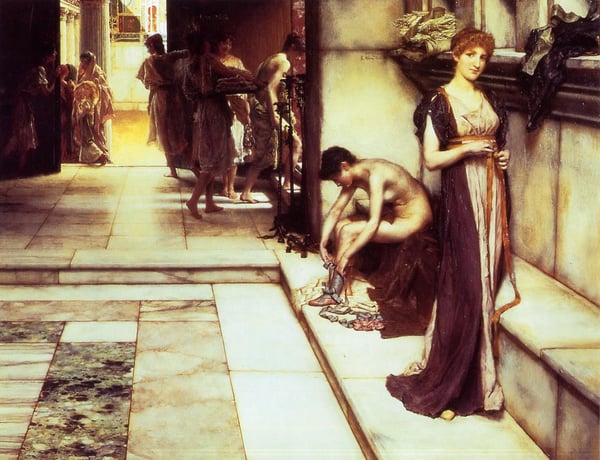
Expert analysis of Sir Lawrence Alma-Tadema’s The Apodyterium
Style: Romanticism · Genre: genre painting
Expert Analysis of “The Apodyterium” by Sir Lawrence Alma-Tadema
Context and Stylistic Significance
Though Sir Lawrence Alma-Tadema is often celebrated for his meticulous reconstructions of ancient Roman daily life, this work—classified under Romanticism as a genre painting—invites us to see how Romantic ideals could suffuse even the most quotidian, historically anchored scene. The apodyterium (the changing room of a Roman bath) becomes a stage for Romanticism’s fascination with the distant past, sensory opulence, and the evocation of mood. Alma-Tadema does not merely document architecture; he infuses the marble, the play of light on polished stone, and the quiet interaction of figures with a palpable sense of nostalgia and intimacy.
What Makes It Significant
-
Romanticism’s Historical Sublime – While Romanticism is often associated with dramatic landscapes or heroic emotion, Alma-Tadema redirects that energy into the mundane luxury of Roman life. The overwhelming detail—veined marble, warm sunlight filtering through a high window, the tactile texture of fabrics—creates a dreamlike immersion that is profoundly Romantic in its yearning for a bygone, idealized era.
-
Genre Painting Elevated – As a genre painting (scenes of everyday life), “The Apodyterium” transcends simple anecdote. Alma-Tadema’s composition balances the private, human moment (a bather adjusting her tunic, another lounging) with a grand, almost sacred architectural setting. This fusion of the ordinary and the monumental aligns with Romanticism’s belief that profound emotion can be found in the simplest human actions when framed by history and beauty.
-
Archaeological Romanticism – Alma-Tadema’s famed archaeological precision serves Romanticism’s desire to resurrect the past not as dry data but as a living, sensuous experience. The painting’s significance lies in its ability to make ancient Rome feel intimate and contemporary—a hallmark of Romantic historicism, where the past is not a relic but a vivid emotional landscape.
In sum, “The Apodyterium” stands as a unique example of Romantic genre painting, using meticulous detail and atmospheric light to transform a Roman changing room into a reverie on mortality, pleasure, and the fleeting beauty of daily life. It challenges us to see Romanticism not only in stormy skies and heroic struggle but in the quiet glow of sunlit marble.
Museum / Gallery
Visually similar
20 works with related composition and palette
The Frigidarium
Sir Lawrence Alma-Tadema
A Favourite Custom
Sir Lawrence Alma-Tadema
After the Dance
John William Waterhouse
The Women of Amphissa
Sir Lawrence Alma-Tadema
An Oleander
Sir Lawrence Alma-Tadema
Corner of the Marketplace
Edward Poynter
Welcome Footsteps
Sir Lawrence Alma-Tadema
The Way to the Temple
Sir Lawrence Alma-Tadema
Shy
Sir Lawrence Alma-Tadema
The Sweet Siesta of a Summer Day
John William Godward
Rug Merchants
Ettore Forti
A Reading from Homer
Sir Lawrence Alma-Tadema
Caracalla
Sir Lawrence Alma-Tadema
The Parting Kiss
Sir Lawrence Alma-Tadema
Midday Slumbers
Sir Lawrence Alma-Tadema

Not at Home Sir
Sir Lawrence Alma-Tadema
The Slave Market
Gustave Boulanger
Yes or No
John William Godward

Liegende
John William Godward
Consulting the Oracle
John William Waterhouse