Theatre Farce
Analisi esperta di Theatre Farce di Kuzma Petrov-Vodkin
Stile: Post-Impressionism · Genere: genre painting
Expert Analysis of Kuzma Petrov-Vodkin’s Theatre Farce
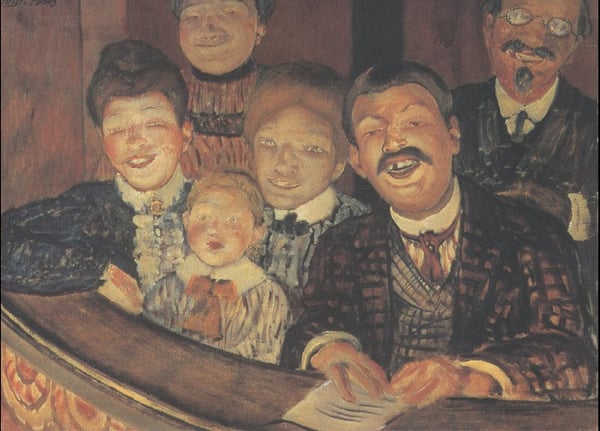
As a work of Post-Impressionist genre painting, Theatre Farce exemplifies Petrov-Vodkin’s distinctive synthesis of Western European avant-garde color theory with the iconographic traditions of Russian Orthodox art. The canvas captures a moment of boisterous popular entertainment—likely a traveling troupe or commedia dell’arte performance—but the artist transforms this everyday scene into a meditation on shape, space, and spiritual tension.
Significance within Post-Impressionism:
Petrov-Vodkin’s palette—acidic greens, deep blues, and sharp reds—pushes beyond naturalism, using color to express psychological intensity rather than mere description. This aligns with the post-impressionist emphasis on subjective emotion. More radically, he employs his signature “spherical perspective,” a system where figures and architecture seem to curve around an unseen globe. In Theatre Farce, this warps the stage and audience into a unified, almost icon-like composition, collapsing physical distance between viewer and performer.
Context and Innovation:
Though a genre scene (a snapshot of everyday life), the painting carries symbolic weight. The farce—traditionally a low, crude comedy—becomes a vehicle for exploring the masks people wear in society. Petrov-Vodkin’s figures, with their simplified, sculptural forms and tilted eyes, echo Byzantine icons, adding a layer of timeless ritual to the fleeting theatrical moment. This fusion of earthy subject matter with sacred spatial logic is what marks the work as significant: it bridges the decorative energy of Matisse with the solemnity of Russian religiosity, offering a uniquely national take on Post-Impressionism.
Key Takeaways:
- Demonstrates Petrov-Vodkin’s spherical perspective, distorting space for emotional effect.
- Use of color to heighten drama and disconnect from literal representation.
- Subverts the genre’s typical triviality by infusing it with iconographic stillness—a hallmark of the artist’s mature style.
- Reflects the broader post-impressionist drive to move beyond impressionist surface effects toward deeper symbolic structures.
Visivamente simili
20 opere con composizione e palette affini
Theatre drama
Kuzma Petrov-Vodkin
Работницы Уралмаша в ложе театра
Юрий Пименов
Family Portrait
Boris Kustodiev
The Turkish Family
Jules Pascin
S. Junyer-Vidal with woman beside him
Pablo Picasso
Family Portrait
Suzanne Valadon
The Grand Tier
Henri de Toulouse-Lautrec
At the Cafe-Concert
Edouard Manet
The Cafe
Pierre-Auguste Renoir
The Village Boys
Lucian Freud
Bonnichsen family
Emil Nolde
Portrait of Alexander J. Cassat and His Son Robert Kelso Cassatt
Mary Cassatt
My Host and Hostess
Paul Henry
The Bock Drinkers
Edouard Manet
Child Eating Cherries
Pierre Bonnard
Pierre-Auguste Renoir
Andrey Allakhverdov
At the Cafe
Pierre-Auguste Renoir
Reading the Part
Pierre-Auguste Renoir
The café
Federico Zandomeneghi
The Donkey Show
Jacques-Émile Blanche