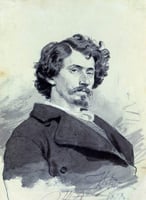
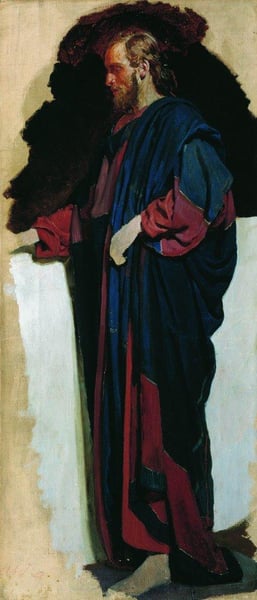
Christ
Analisi esperta di Christ di Ilya Repin
Stile: Realism · Genere: religious painting
Expert Analysis: "Christ" by Ilya Repin
Ilya Repin, a master of Russian Realism, is best known for his unflinching depictions of contemporary social struggles—works like Barge Haulers on the Volga and Ivan the Terrible and His Son Ivan. His turn to the genre of religious painting with Christ (often identified as a study or finished piece from the late 1870s–1880s) is therefore a significant departure, one that reveals the core ambitions of the Realist movement applied to sacred subject matter.
What makes this work significant:
-
Humanizing the Divine within Realism. In the prevailing academic tradition, Christ was depicted as an ethereal, idealized, and often Byzantine figure. Repin, consistent with Realist principles, strips away the divine aura. His Christ is a tangible, suffering human being—weary, deeply introspective, with the dirt of the road and the weight of mortality on His face. This is not the resurrected King, but the man facing Golgotha. Repin’s use of heavy, earthy brushstrokes and somber lighting anchors the figure in a palpable, psychological reality rather than spiritual transcendence.
-
A Dialogue with Repin’s Own Time. Although a religious painting, Christ reflects the late 19th-century Russian intellectual climate, where the figure of Jesus was often reinterpreted as a symbol of social justice, compassion for the oppressed, or existential doubt. Repin’s Christ bears the expression of a man who understands the pain of the world—a subtle but unmistakable echo of the suffering peasantry and the revolutionary undercurrents Repin documented in his secular works. By painting Christ in the Realist mode, Repin collapses the distance between biblical narrative and contemporary human experience, inviting the viewer to see divinity in the ordinary and the downtrodden.
-
Technical Mastery in Service of Psychological Depth. Repin’s handling of light and shadow follows a Realist palette—muted ochres, browns, and grays—eschewing the gilded halos of iconography. The face is modeled with the same rigorous observation Repin applied to his portraits of Tolstoy or Mussorgsky. Every crease, every shadow under the eyes, is a record of lived emotion. This technique makes the viewer feel not that they are looking at an icon, but that they are in the presence of a fellow human being grappling with an immense moral burden.
Conclusion: Repin’s Christ is significant because it represents a radical reinterpretation of a sacred subject through the lens of 19th-century Realism. It challenges the viewer to find the holy in the human, and it stands as a testament to how Realism could infuse even the most traditional genre—religious painting—with new psychological and social urgency. In Repin’s hands, Christ becomes a figure not of distant miracles, but of immediate, overwhelming empathy.
Visivamente simili
20 opere con composizione e palette affini
Estudio de El Greco
Vlady
San Juan Evangelista
Francesco Ribalta
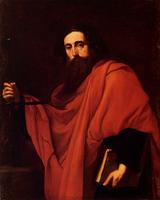
Saint Paul
Jusepe de Ribera
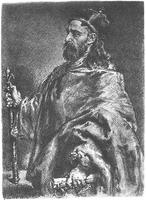
Wladyslaw Herman
Jan Matejko
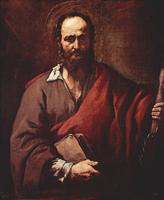
St. Simon
Jusepe de Ribera
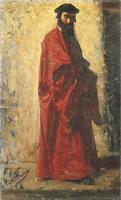
The doge; study for 'The discovery of the corpse of Lorenzino de' Medici'
Cristiano Banti
St. Paul
Nicolas Tournier
Saint Bartholomew
Anthony van Dyck
Apostles Peter and Paul
El Greco
Frederic Lord Leighton
George Frederick Watts
John
Albrecht Durer
Penitent Saint Peter
Dirck van Baburen
St. Paul and St. Peter
El Greco
St. James the Less
El Greco
St. Roch
Jusepe de Ribera
ST. JOHN THE EVANGELIST
Pier Francesco Mazzucchelli
Saint Adelelmus of Burgos
Bartolome Esteban Murillo
Thomas Sandys
Nicolaes Maes
John Philip Kemble
Thomas Lawrence
San Pedro
Vicente Juan Masip