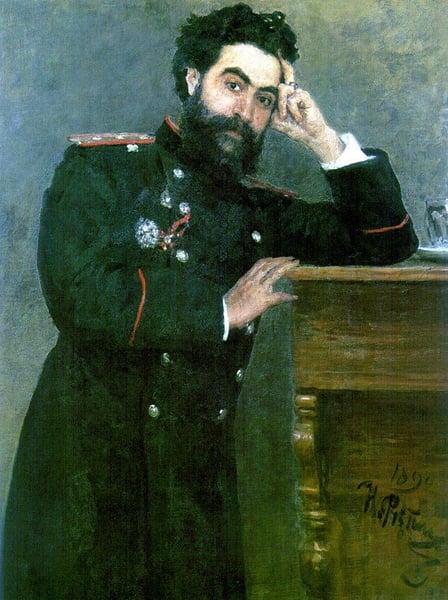
Expert analysis of Ilya Repin’s Portrait of I.R. Tarhanov
Style: Realism · Genre: portrait
As an expert art historian, I will analyze the provided facts to highlight the significance of Ilya Repin’s Portrait of I.R. Tarhanov within the Realist tradition.
Artist & Movement: Ilya Repin (1844–1930) is arguably the most celebrated painter of the Russian Realist movement. His work epitomizes the core tenets of Realism: a rejection of idealized academic convention in favor of truthful, unvarnished observation of contemporary life and human character. Repin’s portraits, in particular, are celebrated for their profound psychological penetration and technical mastery.
Significance within the Portrait Genre: This portrait of I.R. Tarhanov (likely a noted scientist or intellectual, given Repin’s frequent subjects) gains significance from how it embodies the Realist approach to portraiture. Unlike aristocratic or formal portraits that emphasize status or idealized beauty, a Repin portrait treats the sitter as an individual with a specific inner life.
The work’s importance lies in three key aspects:
-
Psychological Intensity: Realist portraiture’s primary goal is to capture the essence of a person—their character, intellect, and emotional state. Repin was a master of this, using a direct gaze, subtle facial expressions, and the natural, unforced pose of the sitter to suggest a moment of introspection or intellectual engagement. In Portrait of I.R. Tarhanov, this psychological depth would be the painting’s central achievement.
-
Technical Virtuosity: Repin’s realism is not merely a photographic copy but a selective, painterly truth. He employed loose, visible brushwork in fabric and background to create a sense of life, while rendering the face with a more concentrated, detailed finish. This contrast—a hallmark of his style—draws the viewer’s eye directly to the sitter’s expression and personality. The handling of light and shadow would be naturalistic, avoiding dramatic theatricality.
-
Cultural and Historical Context: Repin often portrayed the Russian intelligentsia—writers, artists, scientists, and progressive thinkers who were central to the nation’s cultural awakening in the late 19th century. By painting Tarhanov with dignity and penetrating observation, Repin elevates the intellectual and scientific contribution of this figure. The portrait thus becomes not just a likeness, but a document of the era’s respect for reason and humanism.
Conclusion: Portrait of I.R. Tarhanov is significant as a prime example of how Repin translated the Realist manifesto into portraiture. It moves beyond mere representation to become a study of human character, demonstrating that the true subject of Realism is not just the visible world, but the inner world of the individual. The painting stands as a testament to Repin’s ability to capture the soul of his sitter with honesty, empathy, and extraordinary skill, solidifying his place as a towering figure in 19th-century European art.
Visually similar
20 works with related composition and palette
Portrait of Adam Olsufyev
Nikolai Ge
Portrait of E.M. Eygelya
Zinaida Serebriakova
Portrait of the commandant of the Mariinsky Palace, Major-General Pavel Shevelev
Boris Kustodiev
Portrait of Admiral Login Loginovich Heyden
Ivan Kramskoy
Portrait of Nicholas II, The Last Russian Emperor
Ilya Repin
Portrait of A.V. Zhirkevich
Ilya Repin
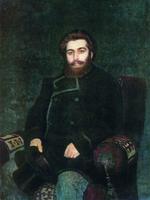
Portrait of the Artist Arkhip Kuindzhi
Ilya Repin
Portrait of Count Sergei Grigoriyevich Stroganov
Konstantin Makovsky
A Soldier
Gustave Caillebotte
Emperor Franz Joseph I in the service uniform of an Austrian field marshal
John Quincy Adams
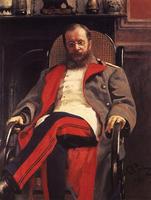
Portrait of Composer Cesar Antonovich Cui
Ilya Repin
Portrait of Emperor Nicholas II
Valentin Serov
Retrado Del General Marcos Segundo Maturana
Pedro Lira
Lee Surrendering to Grant at Appomattox
Alonzo Chappel
Man with a Newspaper
Anton von Werner
A Smoking Soldier
Mikhail Larionov
Portrait of N.D. Milioti
Boris Kustodiev
Young Boy of the Corot Family
Camille Corot
Portrait of Grand Duke Georgy Mikhailovich
Valentin Serov
Portrait of Count Nikolay Sumarokov-Elstone
Valentin Serov