Analisi esperta di Portrait of Sergey Vitte di Ilya Repin
Stile: Realism · Genere: portrait
Expert Analysis: "Portrait of Sergey Vitte" by Ilya Repin
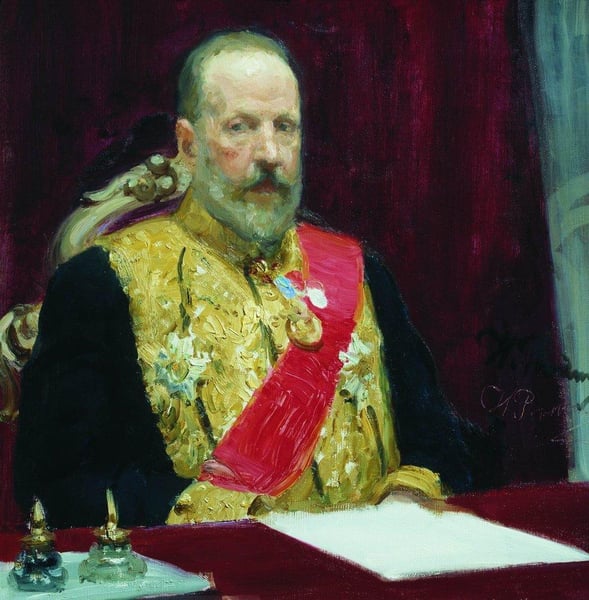
Ilya Repin’s Portrait of Sergey Vitte stands as a quintessential example of Russian Realism, a movement that sought to depict life with unflinching truth and psychological depth. Repin, already celebrated for his monumental narrative works like Barge Haulers on the Volga, here applies his formidable skills to the genre of portraiture, capturing not just the likeness but the very essence of his subject—Sergei Yulievich Witte, the formidable statesman and architect of Russia’s industrial modernization under Tsar Alexander III and Nicholas II.
Stylistic and Technical Significance
Repin’s Realism eschews idealization. The portrait is likely executed with a restrained palette and vigorous brushwork, emphasizing the texture of skin, fabric, and the subtle play of light across Witte’s face. Every detail—from the weary lines around the eyes to the firm set of the mouth—is rendered with a documentary precision that reveals Repin’s academic training and his belief that a portrait should function as a “biography in paint.” This approach elevates the work beyond mere representation; it becomes a psychological study.
Historical and Contextual Depth
Witte was a controversial figure: a brilliant technocrat who oversaw Russia’s trans-Siberian railway and the 1890s industrial boom, yet who later fell from favor after the 1905 Revolution. Repin, who had a keen social conscience (as seen in his sympathetic portrayals of peasants and revolutionaries), does not flatter Witte. Instead, he captures the tension of a man caught between imperial duty and personal ambition. The sitter’s posture and expression convey intelligence, authority, and a hint of weariness—a reflection of the mounting pressures on the late Russian Empire.
Significance Within Repin’s Oeuvre and Realist Portraiture
This portrait is significant because it demonstrates how Realist portraiture functioned as a mirror to society. Repin was not merely recording a politician; he was documenting the human cost of modernization and political upheaval. Unlike the romanticized or flattering portraits of the aristocratic tradition, Repin’s Witte is a real, complex individual. The work aligns with the Peredvizhniki (The Wanderers) movement, of which Repin was a key member, who believed art should serve a moral and social purpose.
In summary, Portrait of Sergey Vitte is a masterwork of Realist portraiture: technically accomplished, psychologically penetrating, and historically anchored. It encapsulates Repin’s ability to find the universal in the specific, making the viewer confront the contradictory forces of personality and power in a changing world.
Visivamente simili
20 opere con composizione e palette affini
Portrait of N.V. Muraviev
Boris Kustodiev
Portrait of War Minister, infantry general and member of State Council State Aleksei Nikolayevich Kuropatkin
Ilya Repin
Portrait of Count D.M. Solsky
Ilya Repin
Portrait of Vladimir Aleksandrovich
Ilya Repin
General of Infantry Christopher Roop
Boris Kustodiev
Portrait of D.M. Solsky
Boris Kustodiev
Portrait of Count K.N. Palen
Ilya Repin
Portrait of Count N.P. Ignatieff
Boris Kustodiev
This is An Image of Hm King George V of the United Kingdom. He is Shown Wearing His Robes as Sovereign Head of the Most Venerable of the Hospital of Saint John of Jerusalem.
Luke Fildes
Portrait of Minister of Ways of Communication and member of State Council, Prince Mikhail Ivanovich Khilkov. Study.
Ilya Repin
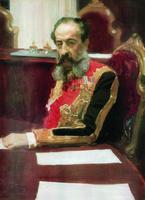
Portrait of member of State Council and Grand Chamberlain, Prince Mikhail Sergeyevich Volkonsky
Ilya Repin
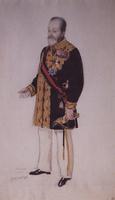
Portrait of Count V.N. Kokovtsev
Boris Kustodiev
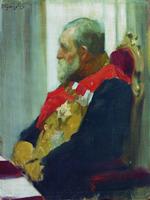
Portrait of P. Salomon
Boris Kustodiev
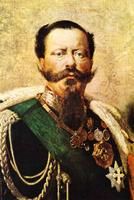
Victor Emanuel II, King of Italy
Tranquillo Cremona
Sketch for the painting Ceremonial Meeting of the State Council on May 7, 1901
Ilya Repin
Portrait of member of State Council Grand Prince Mikhail Aleksandrovich Romanov. Study.
Ilya Repin
Portrait of Prince Sanjō Sanetomi
Harada Naojiro
The Portrait of the King Alexander I
Paja Jovanovic
Josias V. Heeringen
Nicola Perscheid
Reginald Brabazon, 12th Earl of Meath
William Orpen