Paul Cezanne の Apples and Biscuits の専門的な分析
スタイル:Post-Impressionism · ジャンル:still life
Expert Analysis: "Apples and Biscuits" by Paul Cézanne
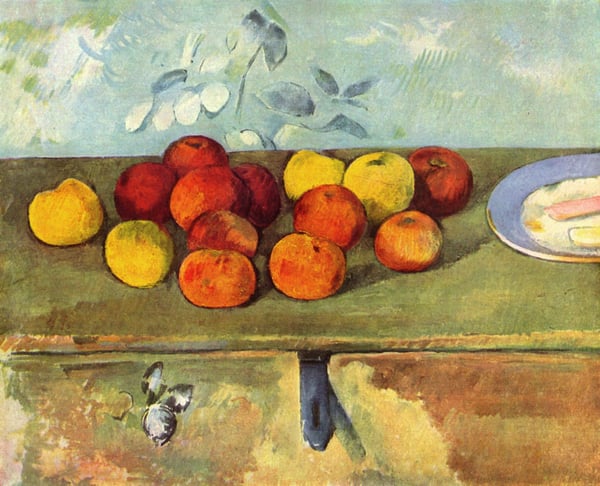
Paul Cézanne’s Apples and Biscuits (c. 1879–1882, though sometimes placed in his final period) is a masterful still life that epitomizes the revolutionary ambitions of Post-Impressionism. Created during the artist’s mature phase—often referred to as his “constructive” period—the work demonstrates Cézanne’s relentless pursuit of structure and stability beneath the surface of ordinary objects.
Significance within Post-Impressionism and the Final Period
Cézanne’s final period (roughly 1890–1906) marks a radical shift away from the fleeting sensations of Impressionism toward a more deliberate, architectural approach to painting. In Apples and Biscuits, this is evident in several key ways:
- Form through color: Cézanne builds the apples and biscuits not with contour lines, but through modulated patches of color. Warm reds, oranges, and yellows create volume, while cool blues and greens define shadows and space. This “constructive stroke” technique anticipates the fractured planes of Cubism.
- Deformed perspective: The tabletop tips upward, the plate appears to tilt, and the biscuits seem to float—Cézanne deliberately disrupts single-point perspective to present multiple viewpoints simultaneously. This flattening of space, while retaining a sense of mass, would become a cornerstone of 20th-century modernism.
- Geometry beneath nature: The apples are reduced to spheres, the biscuits to cylinders, the napkin to a series of faceted folds. Cézanne famously advised artists to “treat nature by means of the cylinder, the sphere, the cone.” Apples and Biscuits is a textbook demonstration of this dictum, as humble objects become vehicles for investigating the underlying geometric order of reality.
Why the Work Endures
This still life is significant because it exists at the threshold of abstraction. Cézanne does not abandon representation—we can still recognize apples, biscuits, and a cloth—but he prioritizes the painterly structure over illusionistic fidelity. The canvas becomes a field of tensions: between two and three dimensions, between warm and cool hues, between texture and symmetry.
For viewers and historians, Apples and Biscuits encapsulates Cézanne’s legacy as the “father of modern art.” It shows how a seemingly simple arrangement of fruit and pastry can become a profound meditation on perception, form, and the very act of seeing. In the context of Post-Impressionism, it stands as a bridge between the sensory immersion of Impressionism and the intellectual rigor of his successors—Matisse, Picasso, and Braque—who would carry his geometric logic into Fauvism and Cubism.
Museum / Gallery
視覚的に類似
構図やパレットが近い作品 20 件
Apples and a Napkin
Paul Cezanne
Still Life
Paul Cezanne
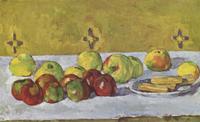
Still life with apples and biscuits
Paul Cezanne
Still life with apples and fruit bowl
Paul Cezanne
Still Life with a Chest of Drawers
Paul Cezanne
Still life with open drawer
Paul Cezanne
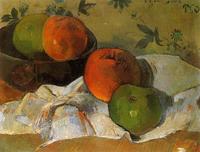
Apples in bowl
Paul Gauguin
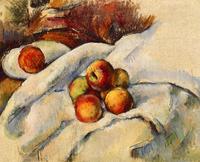
Apples on a Sheet
Paul Cezanne
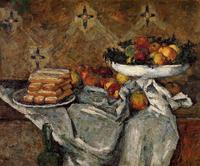
Compotier and Plate of Biscuits
Paul Cezanne
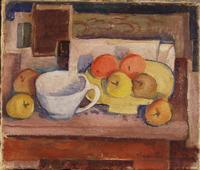
Still Life with Yellow Plate
Kmetty János
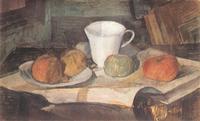
Still Life with Fruits
Kmetty János
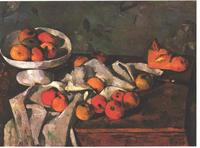
Still life with a fruit dish and apples
Paul Cezanne
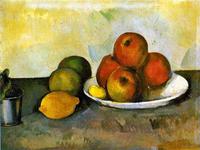
Still life with Apples
Paul Cezanne
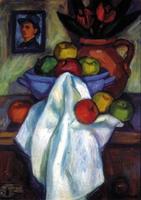
Kmetty Still Life with Self Portrait
Kmetty János
Still life with apples and jug
Paul Serusier
Apples
Federico Zandomeneghi
Apples
Igor Grabar
Apples
Igor Grabar
Still life with apples and green vase
Paul Gauguin
Still Life with Fruits
Kmetty János