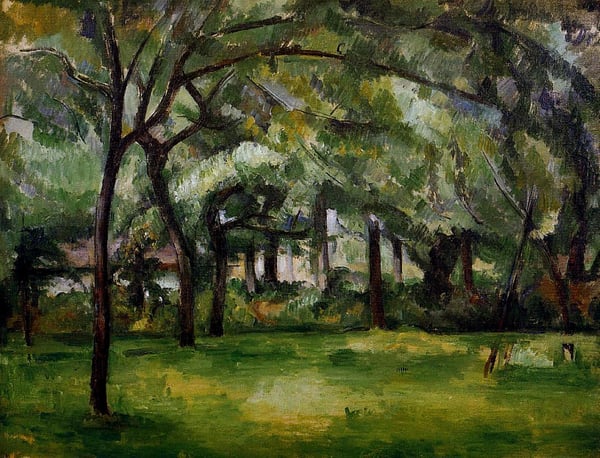
Analyse experte de Farm in Normandy. Summer de Paul Cezanne
Style : Post-Impressionism · Genre : landscape
Expert Analysis: "Farm in Normandy. Summer" by Paul Cézanne
Paul Cézanne’s Farm in Normandy. Summer is a defining work of his mature period, executed within the revolutionary framework of Post-Impressionism. As a landscape, it transcends the fleeting atmospheric effects of Impressionism to assert a new, structural vision of nature—a hallmark of Cézanne’s legacy.
Significance within Style and Period:
-
Post-Impressionist Synthesis: Unlike the spontaneous, optical capture of light in Impressionism, this painting demonstrates Cézanne’s methodical reordering of nature. He breaks down the farm, fields, and sky into simplified geometric forms (cylinders, spheres, cones), anticipating the analytical geometry of Cubism. Each brushstroke builds volume and mass, not just color sensation.
-
Mature Period Mastery: Created during Cézanne’s most influential phase, the work showcases his signature “constructive stroke”—parallel, directional patches of pigment that simultaneously model three-dimensional space and assert the flatness of the canvas. The summer light is not dissolved in dappled sunlight but rendered as a unifying, luminous structure.
-
Genre Transformation: While the subject—a farmstead in Normandy—is traditional, Cézanne subverts conventional perspective. The tilted ground plane and compressed depth challenge the viewer’s spatial expectations, making the landscape a self-contained, formal meditation rather than a documentary view.
-
Legacy for Modernism: This painting embodies the tension between representation and abstraction that would define 20th-century art. Cézanne’s balancing of natural observation with formal invention laid the groundwork for artists from Picasso to Matisse.
In Farm in Normandy. Summer, Cézanne achieves what he called “a harmony parallel to nature”—a pictorial order that feels both timeless and radically new. It is a pivotal statement of Post-Impressionism’s break from naturalism toward a language of pure visual structure.
Museum / Gallery
Visuellement similaire
20 œuvres à la composition et à la palette proches
Forest
Paul Cezanne
Paysage, sketch to the "Strange garden"
Józef Mehoffer
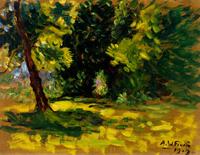
Bushes
Alfred William Finch
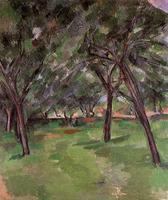
A Close
Paul Cezanne
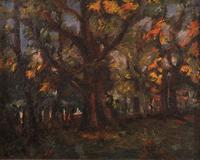
Czóbel Béla Erdőbelső, Olaj, Vászon, 65.5x53cm
Bela Czobel
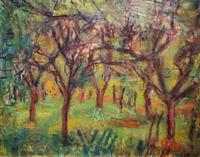
Czóbel Béla Fák a Szentendrei Kertben
Bela Czobel
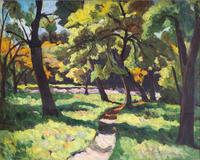
Scheiber Hugó, Park,
Scheiber Hugó
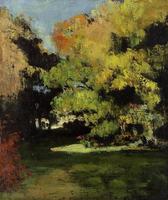
Clearing
Paul Cezanne
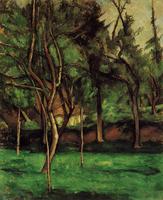
Orchard
Paul Cezanne
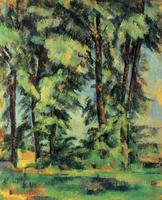
Large Trees at Jas de Bouffan
Paul Cezanne
Modok Mária, Szentendrei Almás Részlet, 1930
Modok Mária
Sunlight after Rain
Robert Julian Onderdonk
Fruit Trees
Claude Monet
Bela Czobel Garden in Szentendre 1949
Bela Czobel
Landscape
Joaquín Sorolla
Landscape
Patrick Henry Bruce
Landscape
Pierre-Auguste Renoir
Paysage À Collioure
Henri Matisse
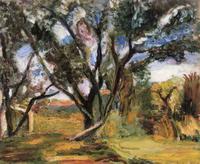
The Olive Tree
Henri Matisse
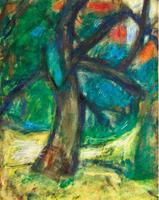
Czóbel Béla , Grosrouvres 1927
Bela Czobel