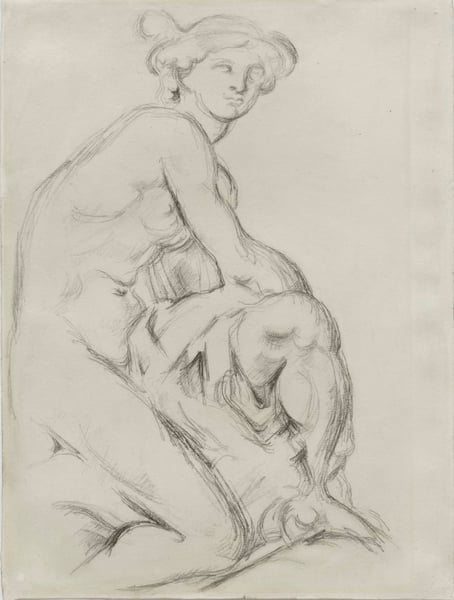
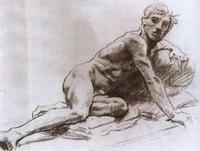
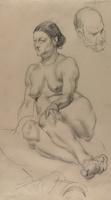
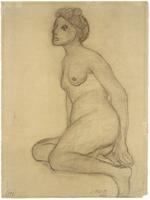
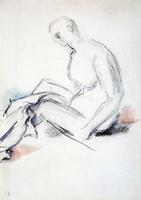
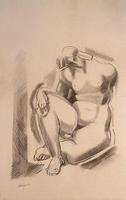
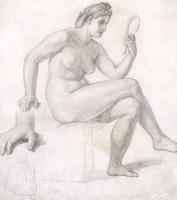
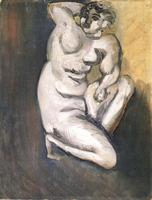
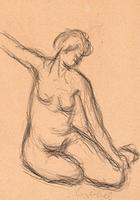
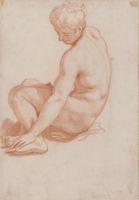
This sketch and study, “Mercury after Pigalle” by Paul Cézanne, is significant as a late-career example of how Post-Impressionism reinterprets classical art through a modern, structural lens. Created during Cézanne’s Final period, the work demonstrates his hallmark move away from naturalistic representation toward a more analytical, geometric simplification of form.
By choosing to sketch a sculpture by Jean-Baptiste Pigalle—a Rococo master of fluid, dynamic figures—Cézanne engages in a dialogue with tradition, yet transforms the subject. In this study, the figure of Mercury is likely compressed into simplified planes and contours, emphasizing volume over anatomical precision. This approach anticipates Cubism and underscores Cézanne’s role as a bridge between Impressionism and 20th-century art.
The work’s significance lies in its status as a “sketch and study”, revealing Cézanne’s artistic process: his method of distilling complex three-dimensional forms into an arrangement of basic shapes and tensions. In his final period, Cézanne’s brushwork became more deliberate and his color more expressive, even in a monochromatic study. This piece thus exemplifies how Post-Impressionism sought not to copy nature (or other art) but to reconstruct it according to the artist’s vision—a principle that would profoundly influence Picasso, Braque, and later abstraction.