
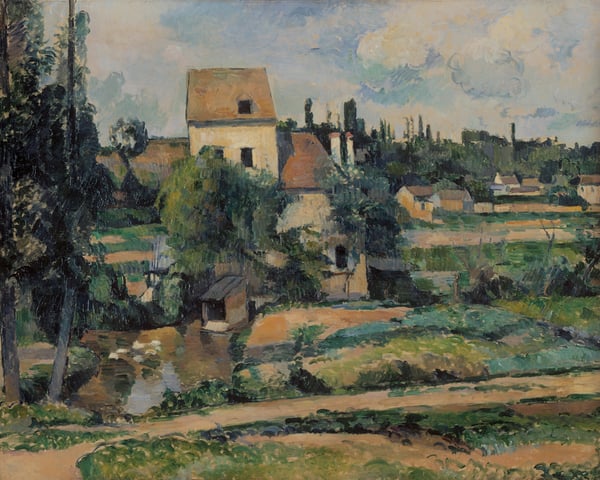
Analisi esperta di Moulin de la Couleuvre at Pontoise di Paul Cezanne
Stile: Post-Impressionism · Genere: landscape
Expert Analysis: "Moulin de la Couleuvre at Pontoise" by Paul Cézanne
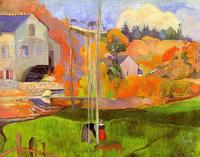
Painted during Cézanne’s mature period, Moulin de la Couleuvre at Pontoise stands as a quintessential example of Post-Impressionist landscape painting and reveals the artist’s pivotal role as a bridge between 19th-century Impressionism and 20th-century Cubism. The work is significant for its radical departure from mere optical transcription toward a deliberate, architectonic structuring of nature.
What makes it significant:
-
Structural Geometry over Atmosphere
Unlike the Impressionists, who prioritized fleeting light and color, Cézanne builds the scene with emphatic, parallel brushstrokes and faceted planes. The mill, trees, and hillside are reduced to simplified cylinders, cones, and cubes—a visual logic that prefigures Cubism. The composition feels both solid and dynamic, as if the forms are being constructed before our eyes. -
Color as Form
Cézanne uses modulated patches of greens, ochres, and blues not just to record local color, but to model volume and spatial depth. Warm tones push forward, cool tones recede, creating a sense of mass without relying on traditional chiaroscuro. This “color-construction” was revolutionary and directly influenced Matisse and the Fauves. -
The “Pontoise” Dialogue with Camille Pissarro
Cézanne worked alongside Pissarro in Pontoise in the early 1870s, but his mature work here shows a decisive shift from Pissarro’s softer, more atmospheric style toward a taut, almost tectonic discipline. The mill becomes a study in balance—between natural growth (the twisting tree) and human-made order (the mill’s geometric roof). -
A Key Work in Cézanne’s Mature Period
This painting exemplifies Cézanne’s goal to “make of Impressionism something solid and durable, like the art of the museums.” The surface is built with deliberate, visible brushwork that unifies the canvas while respecting the flatness of the picture plane—a paradox that would obsess modernists for decades.
In essence, Moulin de la Couleuvre at Pontoise is not a decorative landscape but a philosophical inquiry into how we see and represent three-dimensional reality on a flat surface. Its significance lies in how Cézanne transforms a humble provincial mill into a monumental essay on form, color, and pictorial structure—making it a cornerstone of his legacy and a direct ancestor of 20th-century abstraction.
Museum / Gallery
Visivamente simili
20 opere con composizione e palette affini
Farm in Osny
Paul Gauguin
Landscape in Normandy
Pierre-Auguste Renoir
Abandoned House
Alfred Sisley
Kitchen Garden at the Hermitage, Pontoise
Camille Pissarro
Essoyes Landscape
Pierre-Auguste Renoir
Landscape with Waterline
Paul Cezanne
The House on Water
Henri Martin
Les mathurins, Pontoise
Camille Pissarro
Cote du Galet, at Pontoise
Paul Cezanne
In the Oise Valley
Paul Cezanne
The Effect of Snow at Hermitage
Camille Pissarro
The Labastide du Vert in Spring
Henri Martin
Flood in Pontoise
Camille Pissarro
The Hermitage at Pontoise
Camille Pissarro
Marie Louise House
Henri Martin
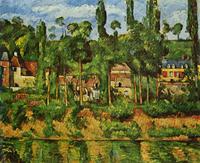
The Chateau de Medan
Paul Cezanne
The Brook at Osny
Camille Pissarro
Marie Louise House in Spring
Henri Martin
A Cowherd on the Route de Chou, Pontoise
Camille Pissarro
A breton landscape. David's mill.
Paul Gauguin