Expert analysis of Paul Cezanne’s Pastoral, or Idyll
Style: Romanticism · Genre: genre painting
Expert Analysis of Paul Cézanne’s Pastoral, or Idyll
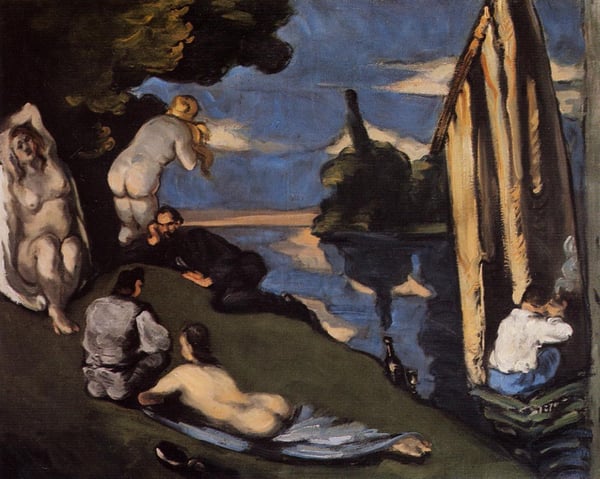
Despite being commonly associated with Post-Impressionism, this work by Paul Cézanne is classified within Romanticism as a genre painting, executed during the broader Impressionist period. That tension alone makes the piece historically significant: it captures a moment when Cézanne was both absorbing and resisting the dominant artistic currents of his time.
Composition and Subject
As a genre painting, Pastoral, or Idyll depicts an everyday (if idealized) scene of rural life—likely figures in a landscape engaged in leisurely or rustic activities. The term “idyll” explicitly evokes a Romantic longing for a simpler, harmonious existence, a theme that was already giving way to the more immediate, optical concerns of Impressionism. Cézanne here holds onto the Romantic tradition of narrative and emotion, even as his contemporaries (Monet, Renoir) were dissolving form in light and color.
Stylistic Hybridity
What makes this artwork significant is how it bridges two worlds. The Romantic style supplies a moody, atmospheric sensibility—soft edges, a poetic treatment of nature, and a focus on human feeling. Yet the period of execution places it squarely in the Impressionist era, when artists were breaking from the studio to paint en plein air. In this painting, we can see early signs of Cézanne’s later structural rigor: the landscape begins to be built from deliberate, almost architectural planes, while the figures retain a Romantic softness. It is not yet the fully realized “constructive stroke” of his mature years, but the seed is present.
Significance
Pastoral, or Idyll is significant because it documents Cézanne’s transitional phase—a moment when the Romantic ideal of a pastoral narrative met the emerging Impressionist concern with light and atmosphere. The painting demonstrates that Cézanne was, even in this early period, unwilling to abandon the emotional weight of Romantic subject matter. In doing so, it foreshadows his lifelong project: to “make of Impressionism something solid and durable, like the art of the museums.” Here, the solidity of the classical pastoral tradition is beginning to be re-forged in a modern, Impressionist crucible. This work thus serves as a crucial missing link between Romantic storytelling and the structural revolution of Post-Impressionism.
Museum / Gallery
Genre
Style
Visually similar
20 works with related composition and palette
Bathers
Paul Cezanne
The River
Pierre Puvis de Chavannes
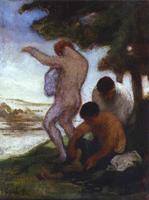
Bathers
Honore Daumier
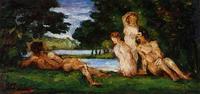
Bathers
Paul Cezanne
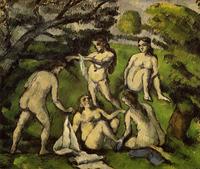
Five Bathers
Paul Cezanne
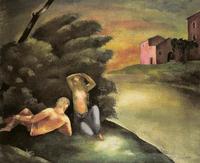
Idyll
Eugeniusz Zak
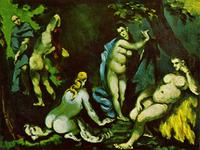
The Temptation of St. Anthony
Paul Cezanne
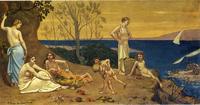
The Happy Land
Pierre Puvis de Chavannes
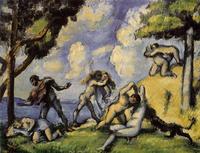
The Battle of Love
Paul Cezanne
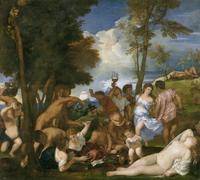
The Bacchanal of the Andrians
Titian
Diana dormida
Frans Wouters
Treated by the Muses
Jacob Jordaens
Nymphs and Satyrs
Peter Paul Rubens
Bathing (Pastoral)
Eugeniusz Zak
Nymphs And Children In a Landscape With Shepherds
Giorgione
Diana and Actaeon
Jacopo Bassano
Pan punished by the Nymphs
Jacob Jordaens
Four nude boys
Alexander Ivanov
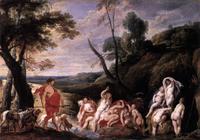
Diana and Actaeon
Jacob Jordaens
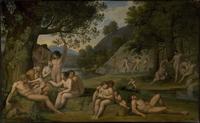
The golden age
Franz Ludwig Catel