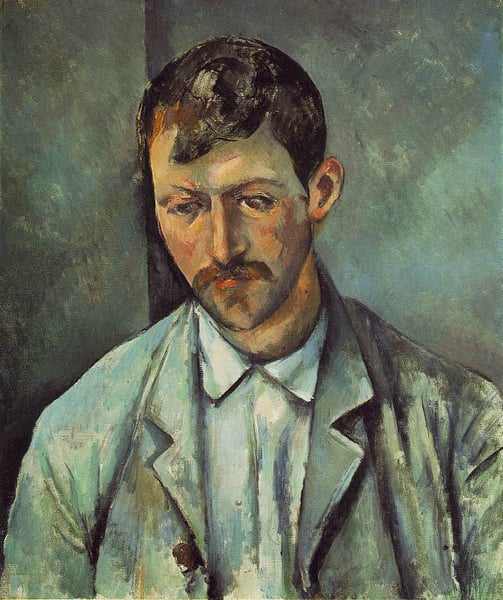
Экспертный разбор работы «Peasant» художника Paul Cezanne
Стиль: Post-Impressionism · Жанр: portrait
Expert Analysis: "Peasant" by Paul Cézanne
Paul Cézanne’s Peasant (c. 1895–1900) stands as a defining work of his final period and a cornerstone of Post-Impressionism. Executed in the last decade of the artist’s life, this portrait exemplifies the radical simplification and structural rigor that would profoundly shape the trajectory of modern art—particularly Cubism and abstraction.
Significance within Post-Impressionism and Cézanne’s Final Period
Cézanne’s late portraits, including Peasant, are remarkable for their departure from naturalistic representation. Rather than capturing a fleeting likeness or psychological state, the artist systematically reduces the figure to geometric components—cylindrical arms, block-like hands, and a faceted face. The sitter is not individualized but becomes a universal archetype of rural life, stripped of anecdote or sentiment. This approach aligns with Cézanne’s famous dictum to “treat nature by the cylinder, the sphere, the cone.”
The brushwork in this painting is equally significant: short, parallel, hatched strokes build up the form in a mosaic of color patches. These strokes do not blend smoothly but remain visible, creating a tension between flatness and volume. The palette is earthy—ochres, olive greens, blue-greys—with subtle shifts of hue modelling the face and clothing. This method anticipates the fragmentation of form found in early Cubism, and indeed Picasso and Braque acknowledged Cézanne as their primary influence.
Technical and Stylistic Innovations
- Distortion and balance: The peasant’s posture feels slightly asymmetrical, yet the composition is carefully balanced. Cézanne distorts anatomy to achieve a more stable pictorial structure, sacrificing realism for harmony.
- Integration of background: The background (likely a studio wall or landscape) is painted with equal importance to the figure, abolishing the traditional hierarchy. The wall seems to press forward, merging figure and ground into a single architectural field.
- Monumentality from simplicity: Despite the unassuming subject, the peasant possesses a monumental gravity. This elevation of a common laborer into an icon of stability reflects Cézanne’s broader aim to make Impressionism “something solid and enduring like the art of museums.”
Why This Work Matters
Peasant is significant because it embodies the final synthesis of Cézanne’s life’s work: the pursuit of pictorial logic over optical truth. In his late period, Cézanne moved beyond Impressionism’s fleeting sensations to construct a timeless, ordered reality. This painting—along with his other late portraits of peasants, gardeners, and his wife—served as a laboratory for the modernist revolution. Without Cézanne’s radical reimagining of form, the innovations of Matisse, Picasso, and Mondrian would have been inconceivable. Peasant thus stands as a quiet but revolutionary manifesto: a portrait that is no longer about a person, but about painting itself.
Museum / Gallery
Визуально похожие
20 работ с близкой композицией и палитрой
The beggar of Livorne
Amedeo Modigliani
The Smoker
Paul Cezanne
Omakuva
Sallinen Tyko
Self-Portrait
Henri Matisse
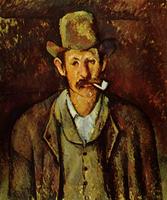
Man with a Pipe
Paul Cezanne
Self-Portrait with Gray Felt Hat
Vincent van Gogh
Self-portrait
Vilhelm Hammershoi
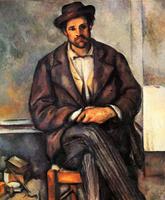
Seated Peasant
Paul Cezanne
Self Portrait
Boris Kustodiev
King George V
Solomon Joseph Solomon
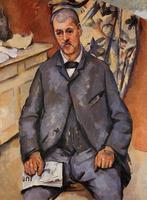
Seated Man
Paul Cezanne
Adolf Loos
Oskar Kokoschka
Portrait of Alexander Reid
Vincent van Gogh
Portrait of the painter Arturo Fittke
Umberto Veruda
Portrait of L.P. Albrecht
Boris Kustodiev
Chauvel
Marcel Duchamp
Self-portrait
Alexej von Jawlensky
Portret of an artist
Nina Arbore
Self-Portrait with Pipe and Glass
Vincent van Gogh
Munkásember
Bela Czobel