Analisi esperta di Portrait of the Artist's Son di Paul Cezanne
Stile: Post-Impressionism · Genere: portrait
Expert Analysis: "Portrait of the Artist's Son" by Paul Cézanne
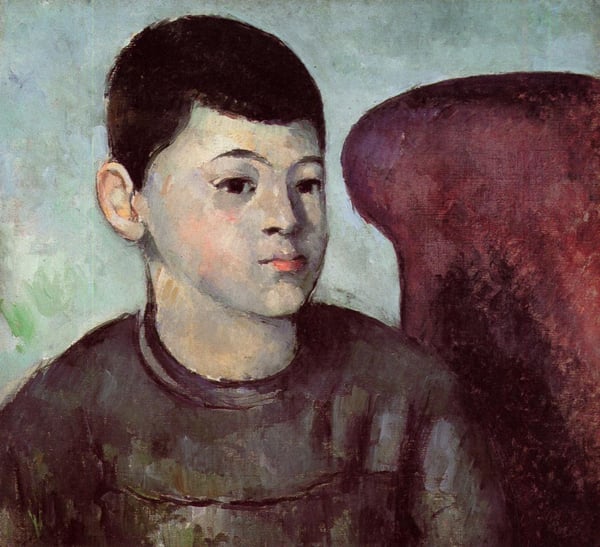
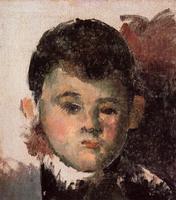
This work belongs to Cézanne’s mature period, a phase in which he systematically deconstructed visual perception in ways that would lay the groundwork for Cubism and modern abstraction. As a Post-Impressionist portrait, it transcends mere likeness to become a study in the artist’s revolutionary approach to form, color, and spatial tension.
Significance within Style and Period
In this portrait of his son, Paul Cézanne demonstrates his signature method of building form through modulated color rather than traditional chiaroscuro. The face is constructed with small, parallel brushstrokes of green, ochre, and blue—tones that model planes without relying on smooth gradations. This technique flattens the picture plane while simultaneously giving the child a remarkable sculptural solidity, a hallmark of Cézanne’s mature style.
The composition reflects Cézanne’s interest in distorting perspective for expressive and structural ends. The boy’s head is slightly oval, the shoulders asymmetrical, and the background (often a simple wall or drape) tilts forward, pressing the figure into the viewer’s space. Such deliberate “errors” reject Renaissance perspective in favor of a more immediate, perceptual truth—a key Post-Impressionist concern.
Psychological and Artistic Weight
Unlike earlier portraits that aimed to capture a sitter’s social status or personality, Cézanne’s portrait of his son emphasizes the act of seeing itself. The child’s eyes are slightly out of focus, the contours broken and re-asserted. This results in an image that feels both intimate and monumental—a son reduced to his essential geometric components, yet undeniably present.
This painting is significant because it embodies the transition from 19th-century naturalism to 20th-century abstraction. By prioritizing structure over sentiment, Cézanne transforms a simple paternal subject into a profound meditation on how we perceive form in space. It is a quiet masterpiece of the mature period, showing how a personal, domestic subject could become a laboratory for the new visual language that Picasso and Braque would soon radicalize.
Museum / Gallery
Visivamente simili
20 opere con composizione e palette affini
Clovis
Paul Gauguin
The daughter of an artist
Kuzma Petrov-Vodkin
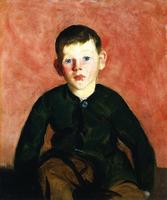
A Village Boy
Robert Henri
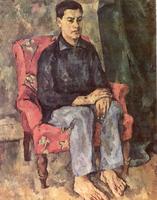
Portrait of a son
Pyotr Konchalovsky
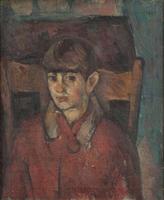
Portrait of Azadoohi (Liberty Miller)
Arshile Gorky
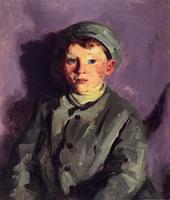
Bucko O'Malley (Charles)
Robert Henri
Portrait of the Artist's Son
Paul Cezanne
Head of a boy
Silvestro Lega
Pat
Robert Henri
The poor girl
Pellizza da Volpedo
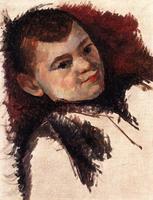
Portrait of the Artist's Son
Paul Cezanne
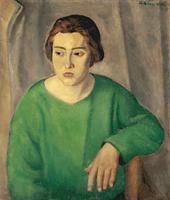
Portrait of his sister Sagrario
Esteban Vicente
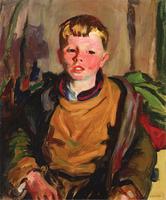
MacNamara
Robert Henri
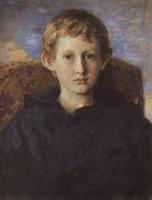
Portrait of Boris Vasnetsov, son of the artist
Viktor Vasnetsov
Thomas in His Red Coat
Robert Henri
Madame Cezanne with a Yellow Armchair
Paul Cezanne
Self Portrait
Max Weber
Butts
George Luks
Niño vestido de verde
Andres de Santa Maria
Portrait of Oleg Yuon, the artist's grandson
Konstantin Yuon