Expertenanalyse zu Paul Cezannes Still Life Apples and Pears
Stil: Post-Impressionism · Genre: still life
Expert Art Historical Analysis: Still Life Apples and Pears by Paul Cézanne
Style: Post-Impressionism
Genre: Still life
Period: Mature period
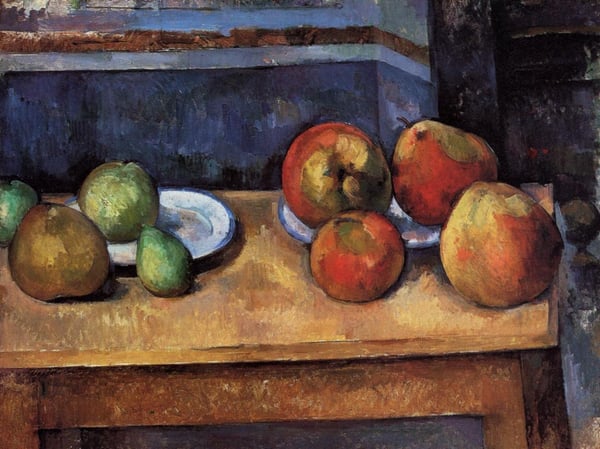
Paul Cézanne’s Still Life Apples and Pears is a quintessential example of his mature period and a landmark in the evolution of modern art. Executed in the late 19th century, the work exemplifies Cézanne’s revolutionary approach to representation, abandoning the single-point perspective and naturalistic replication that had dominated Western painting since the Renaissance.
Formal Innovation and “Constructive Stroke”
Cézanne builds the composition not through linear outlines or atmospheric shading, but through the meticulous modulation of color and directional brushstrokes. Apples and pears become solid, almost sculptural volumes, created by juxtaposing warm and cool hues—yellows, greens, reds, and blues—that simultaneously define shape, light, and space. This technique, often called the constructive stroke, flattens the picture plane while giving objects a tangible, physical presence. The tabletop tilts upward, refusing a traditional recession into depth; the fruit seems to hover in a shallow, ambiguous space that anticipates the spatial dislocations of Cubism.
Multiple Viewpoints and Pictorial Unity
A hallmark of Cézanne’s mature style is the use of multiple, simultaneous viewpoints. In Still Life Apples and Pears, the table is seen from above, the fruit from slightly different angles, and the background drapery from the side—all reconciled on a single canvas. This deliberate distortion challenges the viewer’s habitual ways of seeing, insisting that painting is not a window onto reality but a self-contained, constructed world. The resulting tension between three-dimensional volume and two-dimensional surface gives the still life its dynamic, rigorous harmony.
Influence on Modern Art
Cézanne’s still lifes, more than his landscapes or portraits, became the laboratory for his formal experiments. Still Life Apples and Pears is significant because it demonstrates how ordinary objects—fruit, a cloth, a table—can be elevated into a complex meditation on perception, structure, and color. This work directly influenced Pablo Picasso and Georges Braque as they developed Cubism, and it paved the way for abstract art by showing that the painter’s primary task is not to copy nature but to build a coherent, self-referential pictorial reality. In Cézanne’s hands, the humble still life became a vehicle for profound artistic revolution.
Museum / Gallery
Visuell ähnlich
20 Werke mit ähnlicher Komposition und Farbpalette
Still Life. Tashkent.
Pyotr Konchalovsky
Still life
Paul Cezanne
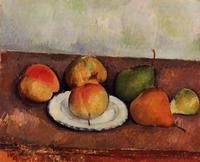
Still Life Plate and Fruit
Paul Cezanne
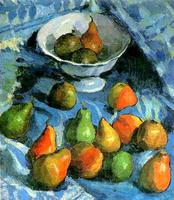
Still Life with Pears
Igor Grabar
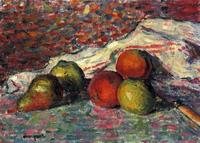
Fruit, Knife and Napkin
Albert Marquet
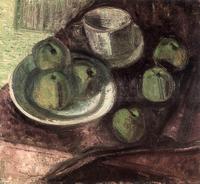
Green Quinces
Istvan Ilosvai Varga
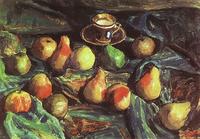
Pears on a Green Cloth
Igor Grabar
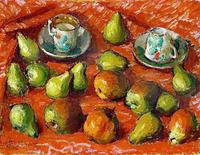
Still life in red tones with fruit and cups
Igor Grabar
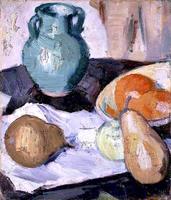
The Green Jar
Samuel Peploe
Still Life in Green
Helene Schjerfbeck
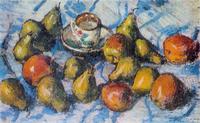
Apples and Pears
Igor Grabar
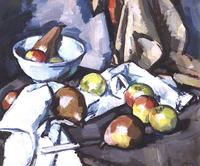
Still Life. Fruit
Samuel Peploe
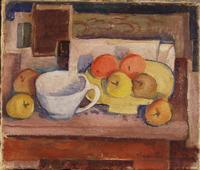
Still Life with Yellow Plate
Kmetty János
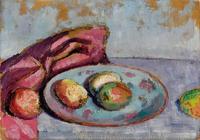
Still Life
Theophrastos Triantafyllidis
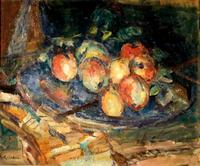
Still Life with Fruits
Michel Kikoine
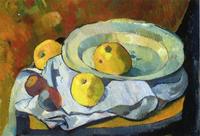
Plate of Apples
Paul Serusier
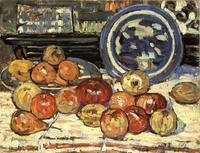
Still Life with Apples
Maurice Prendergast
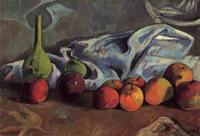
Still life with apples and green vase
Paul Gauguin
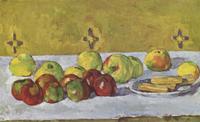
Still life with apples and biscuits
Paul Cezanne
Still Life
Paul Serusier