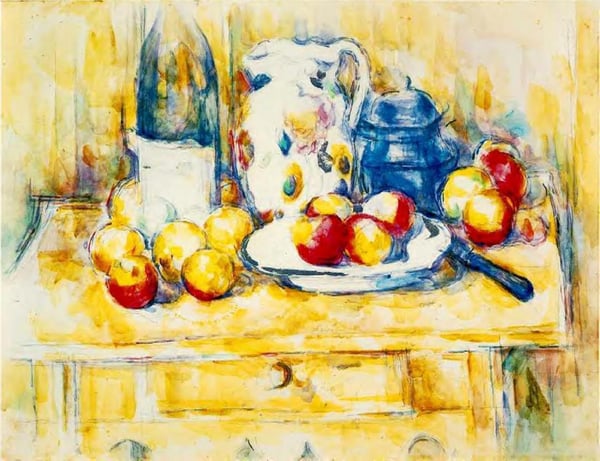
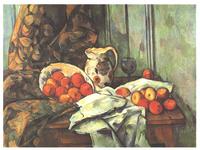
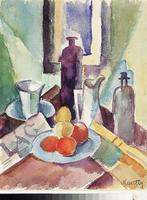
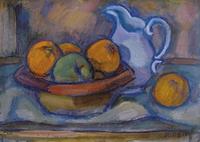
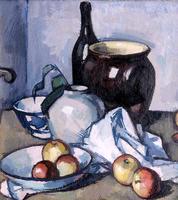
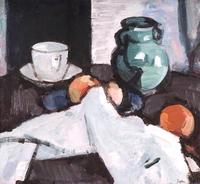
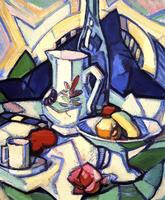
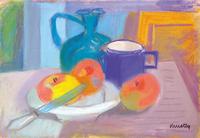
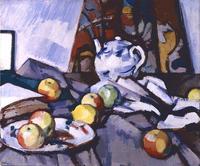
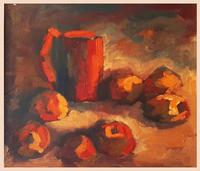
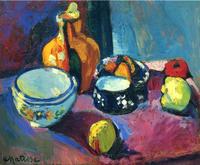
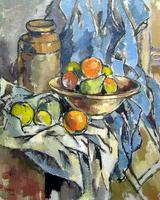
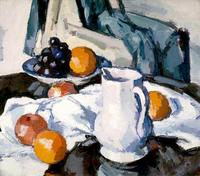
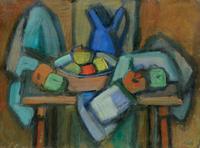
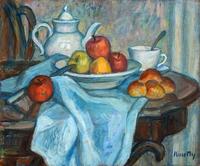
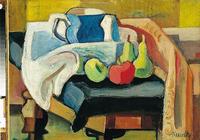
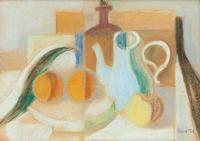
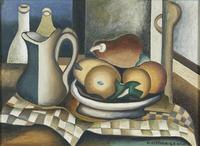
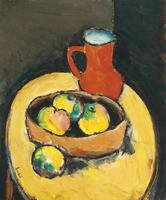
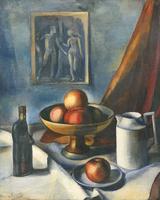
This work, painted in Cézanne’s final period (roughly 1895–1906), epitomizes his revolutionary approach to still life. Significance lies in its relentless construction of form through color and the deliberate distortion of perspective. The apples are not simple depictions but studied spheres built from small, distinct brushstrokes of warm ochres, greens, and reds—each touch a facet of volume. The bottle and milk pot are cylindrical counterpoints, their cold whites and blues set against the fruit’s warmth.
Crucially, the tabletop tilts upward, as if the viewer’s eye must move around the objects to grasp their fullness. This rejection of a single fixed viewpoint dismantles Renaissance perspective, making the flat canvas both a window and a constructed surface. The “empty” spaces between objects are just as active: the dark bottle contrasts with the pale milk pot, while the cloth’s folds create a rhythmic flow.
Cézanne’s final still lifes are often called “the father of Cubism.” Here, geometry (spheres, cylinders, cones) is not imposed but discovered in nature. The paintings thereby achieve a timeless, monumental stillness—a sense that these humble objects are as weighty as mountains. This work stands as a key document of modern art’s shift from representation to structure.