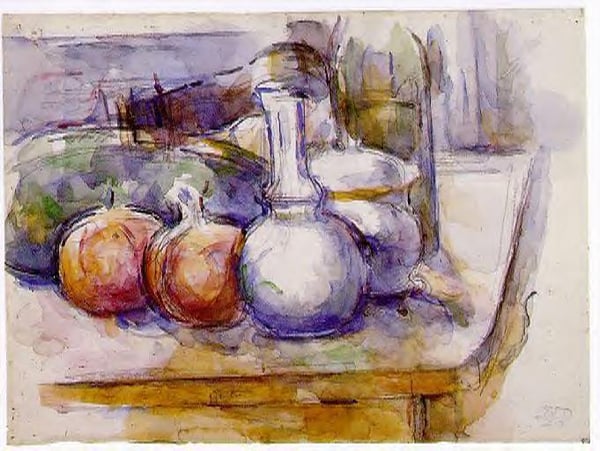
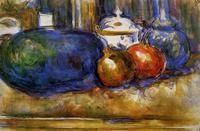
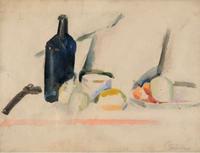
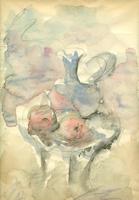
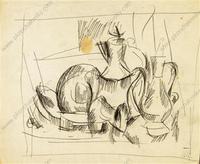
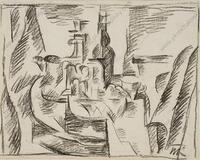
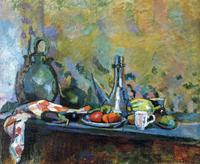
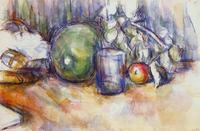
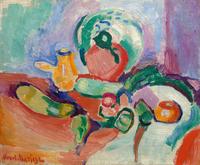
Expert Analysis: "Still Life with Carafe, Sugar Bowl, Bottle, Pomegranates and Watermelon" by Paul Cézanne
This still life exemplifies Cézanne's revolutionary approach within Post-Impressionism, a movement that sought to move beyond Impressionism's fleeting effects toward structure and permanence. Cézanne’s work is significant for its deliberate flattening of pictorial space and its use of multiple, shifting perspectives—techniques that would later directly inspire Cubism.
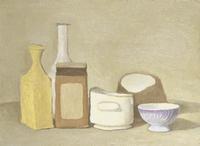
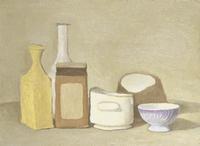
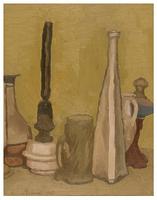
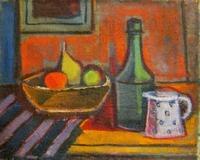
In this composition, ordinary objects—a carafe, sugar bowl, bottle, pomegranates, and watermelon—are rendered with thick, parallel brushstrokes and a muted, earthy palette, emphasizing geometric forms over realistic detail. The tabletop tips upward, while fruits appear simultaneously from different angles, challenging traditional single-point perspective. By reducing objects to cylinders, spheres, and cones, Cézanne transforms the mundane into a meditation on form and color harmony.
As a Post-Impressionist still life, this work marks a pivotal shift from representation to abstraction, asserting that painting should express the artist’s subjective perception rather than merely record visual reality. It stands as a cornerstone of modern art, demonstrating how still life could become a vehicle for radical formal exploration.