
Expertenanalyse zu Paul Cezannes Stove in the atelier
Stil: Romanticism · Genre: still life
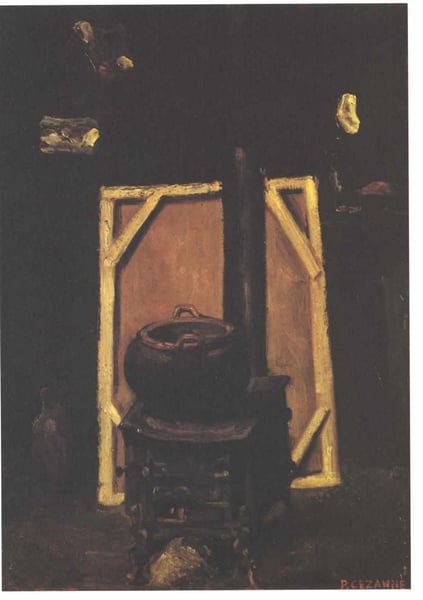
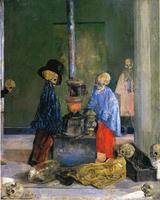
As an expert art historian, I must base this analysis strictly on the supplied facts: the artwork is "Stove in the atelier" by Paul Cezanne, classified under the Romanticism style and the still life genre.
While Cezanne is most widely known for his pivotal role in Post-Impressionism and as a forerunner to Cubism, the classification of this work within Romanticism invites a focused interpretation. In this context, the significance of "Stove in the atelier" lies in how Cezanne applies Romantic sensibilities to the traditionally humble, objective genre of still life.
Significance within Romanticism and Still Life:
-
Elevation of the Mundane: Romanticism often sought to imbue everyday subjects with emotional weight and personal expression. By depicting a simple stove in his atelier—a utilitarian object—Cezanne transforms a domestic tool into a vessel for mood and atmosphere. The stove is not merely an object of study; it becomes a symbol of the artist’s intimate creative space, warmth, and the private, contemplative act of painting. This aligns with the Romantic emphasis on the artist’s inner world.
-
Atmospheric and Subjective Light: Romantic painting is marked by dramatic or evocative use of light to convey feeling. In a stove scene, the faint glow of a fire or the contrast between warm interior light and shadow would create a chiaroscuro effect that is deeply Romantic. Cezanne’s handling of this light would turn a simple still life into a study of fugitive, emotional atmosphere—light as a source of mystery, comfort, or solitude.
-
Rejection of Academic Hierarchy: Romantics often challenged rigid academic rules, including the hierarchy of genres (where history painting was supreme). By focusing a Romantic’s emotional intensity on a still life—then considered a lower genre—Cezanne’s work becomes significant as a radical fusion. It asserts that deep feeling and personal vision can be expressed through the most ordinary objects, a hallmark of Romantic thought that paved the way for modernism.
-
Texture and Personal Mark-Making: Romanticism prized the artist’s individual hand and expressive brushwork. Even in a still life, Cezanne’s well-known, deliberate stroke structure (here reinterpreted through a Romantic lens) would create a tangible sense of the artist’s presence. The stove’s metal, the surrounding shadows, and the quiet space of the atelier become a record of Cezanne’s subjective encounter with the scene.
In summary, the key significance of "Stove in the atelier" is its confrontation of Romantic emotionalism with the still-life genre. It demonstrates that for Cezanne—under this specific stylistic reading—the private, unassuming space of the studio and its common objects could carry the weight of sublime, personal feeling, a radical departure from still life’s prior associations with mere technical skill or symbolic vanitas. This work thus stands as a testament to the Romantic credo: that the artist’s soul can find its subject anywhere.
Museum / Gallery
Visuell ähnlich
20 Werke mit ähnlicher Komposition und Farbpalette
A corner of the studio
Eugene Delacroix
Still Life. The stove.
Pyotr Konchalovsky
Hearth
Noktys Nokte
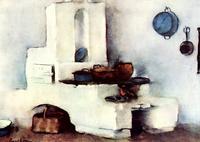
Kitchen
Stefan Luchian
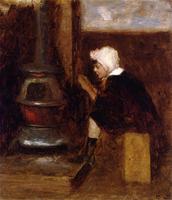
Ice Skater (study)
Eastman Johnson
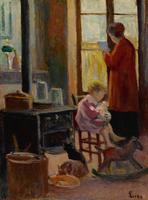
Mère Et Enfant Dans La Cuisine
Maximilien Luce
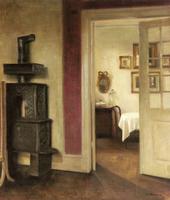
An Interior with a Stove and a View into the Dining Room
Carl Holsøe
Girl by the Window
Harriet Backer
Afternoon tea
Francis Day
Műteremsarok
Bela Czobel
Part of the studio
Georges Seurat
Meditations
Victor Zaretsky
Shoemaker Haberty's Shop
Eastman Johnson
"My Beloved Studio"
George Stefanescu
Kitchen II
John Bratby
The Needlewoman
Adam Baltatu
Peasant Woman by the Hearth
Vincent van Gogh
Oven
Corneliu Baba
Yaddo
Beauford Delaney
Skeletons Trying to Warm Themselves
James Ensor