
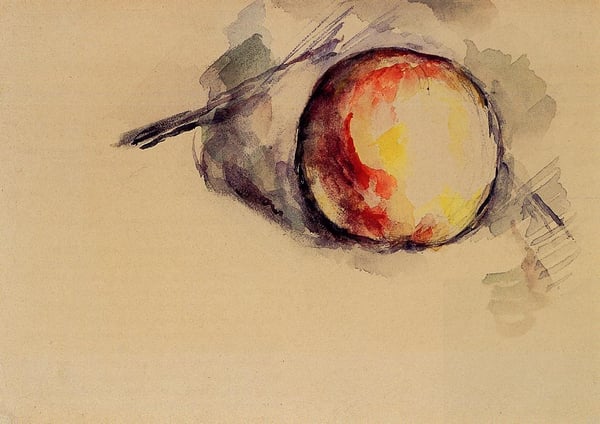
Analisi esperta di Study of an Apple di Paul Cezanne
Stile: Post-Impressionism · Genere: sketch and study
Expert Analysis: "Study of an Apple" by Paul Cézanne
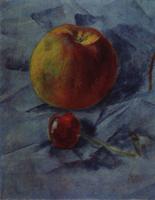
Paul Cézanne’s Study of an Apple is a quintessential example of his mature period, encapsulating the very principles that would elevate the humble still life into a radical artistic statement. As a Post-Impressionist sketch and study, this work holds profound significance not as a finished masterpiece, but as a window into Cézanne’s revolutionary process—a process that dismantled traditional perspective and rebuilt form through color and geometry.
Significance within Post-Impressionism and the Mature Period
In the context of Post-Impressionism, Cézanne rejected the fleeting effects of light and atmosphere pursued by the Impressionists. Instead, he sought a more enduring, structural truth in nature. Study of an Apple embodies this shift: the sketch-like quality—with visible, deliberate brushstrokes and unblended patches of paint—prioritizes the artist’s analytical eye over surface finish. The apple is not merely a fruit; it is a compressed sphere of volume, modulated by warm ochres, cool greens, and pale blues that suggest both form and space. This method of “building” form with color—rather than line or shading—was Cézanne’s signature breakthrough.
As a study from his mature period (roughly the 1880s–1890s), this work exemplifies Cézanne’s obsession with the “little sensation” of perceiving form. The apple is rendered from multiple subtle viewpoints, its contour slightly broken or repeated, hinting at his later, more overtly planar still lifes. This exploratory handling directly anticipates Cubism: Pablo Picasso and Georges Braque would later credit such sketches as the foundation for their own fragmentation of space.
What Makes It Significant
-
The Sketch as a Finished Statement: Unlike a mere preparatory drawing, Study of an Apple is a self-sufficient work. Cézanne’s loose touch and unpainted canvas areas are not signs of incompleteness but of an aesthetic of discovery. The sketch becomes the final record of a perceptual struggle—what the artist called “realizing his sensations.”
-
Harmony of Opposites: Cézanne balances warm and cool tones, solid mass and fleeting light, flatness and depth. The apple’s shadow is built from blue-gray strokes that oscillate between being background and part of the object itself, challenging traditional figure-ground relationships.
-
Influence on Modern Art: This study demonstrates why Cézanne is often called the “father of modern art.” By treating the apple as a sphere to be analyzed through color, he liberated still life from mere representation. Every subsequent movement—from Fauvism to Cubism to Abstract Expressionism—owes a debt to works like this, where a simple apple becomes a microcosm of artistic thought.
In summary, Study of an Apple is significant because it captures Cézanne’s mature faith that painting must be a process of seeing, not illustrating. The sketch is not a rough draft; it is the very essence of Post-Impressionist inquiry—an apple reborn as pure structure and sensation.
Museum / Gallery
Visivamente simili
20 opere con composizione e palette affini
Still Life, Apples
Ottone Rosai
Still-life with Apple
George Stefanescu
Apple
Pablo Picasso
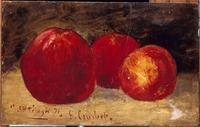
Three Red Apples
Gustave Courbet
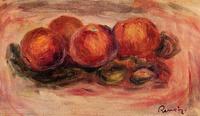
Peaches and Almonds
Pierre-Auguste Renoir
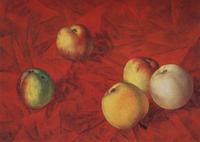
Apples
Kuzma Petrov-Vodkin
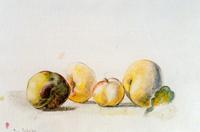
Still Life (quince and pear)
Balthus
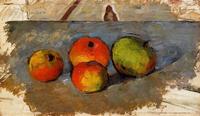
Four Apples
Paul Cezanne
Czobel Aple
Bela Czobel
Still Life
Theophrastos Triantafyllidis
Two Apples
Pierre-Auguste Renoir
Blue Pattern
Igor Grabar
Apples on a Sheet
Paul Cezanne
The green apples
Felice Casorati
Still life
Kuzma Petrov-Vodkin
Peaches
Pierre-Auguste Renoir
Apples
Paul Cezanne
Still life with green apples and pears
Forrest Bess
Apples
Stefan Luchian
Apple and cherry
Kuzma Petrov-Vodkin