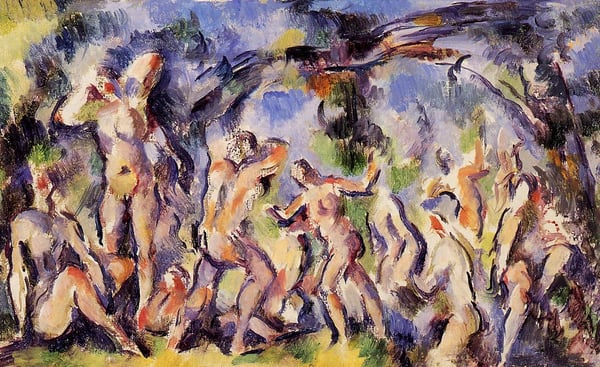
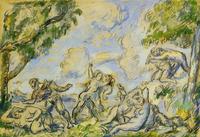
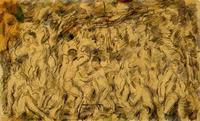
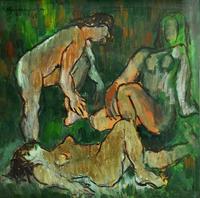
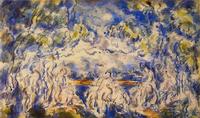
Paul Cézanne’s Study of Bathers is a significant work from his final period, executed within the Cubist style and classified as a genre painting. During this late phase, Cézanne distilled his observations of the human figure into the geometric simplifications and multiple, fractured viewpoints that would later become foundational to Cubism. This study is not a finished composition but rather a concentrated exploration of form—a hallmark of his process—where the bathers are rendered as interlocking planes and volumes, pushing beyond naturalistic representation. Its significance lies in how it bridges the artist’s earlier Impressionist concerns with light and atmosphere and the emerging Cubist focus on structure and space. As a genre painting of everyday leisure, it transforms a common scene into a rigorous formal exercise, demonstrating Cézanne’s pivotal role in redefining modern painting.