
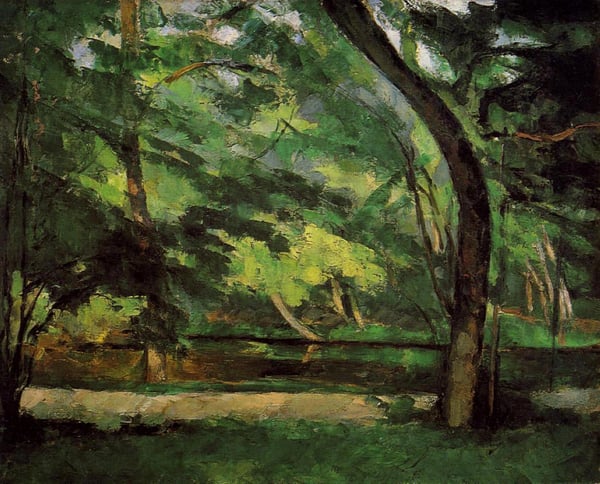
The Etang des Soeurs at Osny
Details
Expertenanalyse zu Paul Cezannes The Etang des Soeurs at Osny
Stil: Impressionism · Genre: landscape
Expert Art Historical Analysis: The Etang des Soeurs at Osny by Paul Cézanne
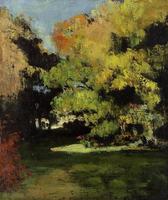
This landscape, painted during Cézanne’s formative Impressionist period (circa 1875–1877), exemplifies a crucial turning point in the artist’s evolution—and in the history of modern art. While it adheres to the Impressionist preoccupation with capturing fleeting light and atmospheric effects, Cézanne’s treatment of the scene already reveals the structural rigor that would later define his Post-Impressionist masterworks.
Significance within the Impressionist Movement
At first glance, The Etang des Soeurs at Osny appears to be a classic Impressionist landscape: a pond edged with trees, their reflections shimmering in the water under a soft, dappled sky. Cézanne worked alongside Camille Pissarro in Osny and Pontoise, and Pissarro’s influence is evident in the bright palette and broken brushwork. Yet even here, Cézanne diverges from pure Impressionism. Instead of dissolving form into evanescent light, he builds the scene with deliberate, parallel strokes of color that emphasize the planar structure of the water, the bank, and the foliage. The pond becomes a geometric patchwork of blues, greens, and earthy tones, where each brushstroke acts as a small, faceted block of color.
Why the Work Matters
- Proto-Cubist Logic: The painting anticipates Cézanne’s later dictum to “treat nature by the cylinder, the sphere, the cone.” The composition is organized into distinct horizontal bands (sky, tree line, water) and vertical accents (the trunks and their reflections), creating a subtle architectural stability that contrasts with the fluidity of typical Impressionist scenes.
- Color as Modeling: Cézanne uses color not just to describe light but to construct volume. The warm ochres and cool greens in the trees and their reflections are carefully balanced, so that even the water feels dense and material—almost sculpted.
- Transitional Work: This painting belongs to a period when Cézanne began to move away from capturing a spontaneous “impression” toward a more analytical, enduring vision of nature. It is a bridge between the shimmering surfaces of Monet and the fractured planes of Cubism.
Conclusion
The Etang des Soeurs at Osny is significant not because it is a perfect Impressionist landscape, but because it shows Cézanne already questioning the movement’s premises. His insistence on structure, pattern, and deliberate color harmony transforms a humble pond into an architectonic meditation on nature’s underlying form. This painting is a seed from which his radical later works—and modern painting itself—would grow.
Museum / Gallery
Visuell ähnlich
20 Werke mit ähnlicher Komposition und Farbpalette
In the Woods
Paul Cezanne
In the park
Isaac Levitan
The Yerres, Effect of Ligh
Gustave Caillebotte
Under the Green Trees (Summer Landscape)
Konstantin Makovsky
Sous Bois
Louis Hayet
Green Grove
Tetyana Yablonska
Le Ru de Valmondois
Charles-Francois Daubigny
The Landscape of Autumn
Grant Wood
Sunbeam
Grigoriy Goldstein
Two Roe Deers in the Forest
Gustave Courbet
Trees by the River
Henri Martin
Oaks in sunlight
Ivan Shishkin
Path in the forest
Isaac Levitan
The Woodland Pool
Robert Julian Onderdonk
Overgrown Pond
Konstantin Somov
Toulouse Landscape
Henri Matisse
Landscape of Cascine
Giorgio de Chirico
Yerres, Path Through the Old Growth Woods in the Park
Gustave Caillebotte
Wooded Water near Blenheim
Winston Churchill
Clearing
Paul Cezanne