
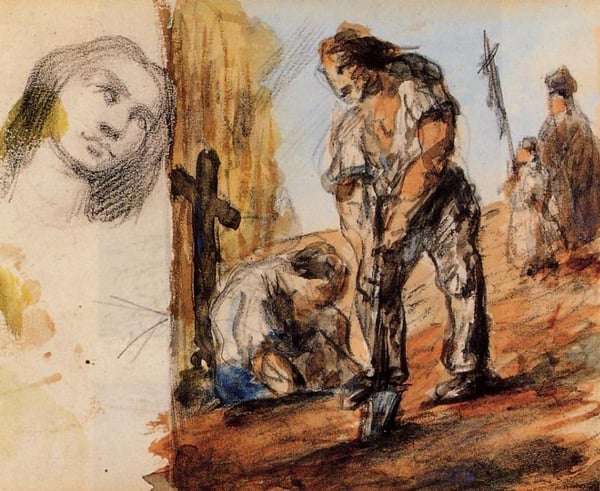
Análisis experto de The Gravediggers de Paul Cezanne
Estilo: Romanticism · Género: sketch and study
Expert Analysis of "The Gravediggers" by Paul Cezanne
Within the structured facts provided, Paul Cézanne’s “The Gravediggers” occupies a unique crossroads: executed as a sketch and study during his Impressionist period, yet stylistically anchored in Romanticism. This duality is precisely what makes the work significant—it captures a pivotal moment of transition, both in Cézanne’s personal development and in the broader shift from Romantic emotionalism to Impressionist observation.
Romanticism in Execution
The subject itself—gravediggers at work—is a quintessentially Romantic trope, laden with mortality, toil, and the sublime terror of death. Cézanne’s handling, even in sketch form, likely emphasizes dramatic chiaroscuro and expressive, gestural lines to evoke a sense of existential weight. The figures are not merely laborers; they are agents of a dark, almost theatrical narrative, echoing the Romantic fascination with the macabre and the human condition.
The Significance of the Sketch and Study
As a preparatory study, this artwork offers a rare window into Cézanne’s creative process during his Impressionist years. The unfinished, rapid quality of the sketch reveals his struggle to reconcile Romantic intensity with the nascent Impressionist interest in light, atmosphere, and fleeting moments. Unlike finished Romantic paintings that fix dramatic scenes, the sketch’s spontaneity aligns more with Impressionism’s ethos of capturing an instant. Thus, “The Gravediggers” is significant because it embodies the tension between two movements: the dark, symbolic weight of Romanticism and the light-driven, plein-air freshness of Impressionism.
Historical Placement
Cézanne is typically celebrated as a Post-Impressionist, yet here we see him working squarely within the Impressionist period (roughly 1870s–1880s) but rejecting its characteristic brightness in favor of a somber Romantic palette. This choice makes the piece a rare outlier—an Impressionist-era work that refuses Impressionist optimism. It foreshadows Cézanne’s later structural explorations, as even in this sketch one can detect his emerging concern with geometric form beneath the Romantic pathos.
In summary, “The Gravediggers” is significant as a transitional artifact: a Romantic subject rendered with the provisional vigor of a study, executed during Cézanne’s Impressionist phase. It underscores that artistic periods are porous, and that even a master like Cézanne could channel older conventions while moving toward the new.
Museum / Gallery
Visualmente similares
20 obras con composición y paleta relacionadas
María Magdalena
Felicien Rops
Samuel Appearing to Saul in the Presence of the Witch of Endor
Ferdinand Bol
Figure Studies for Le Printemps
Pierre Bonnard
Figures
Alekos Kontopoulos
Woman in Dark Dress, Walking
Vincent van Gogh
Projet d'illustration pour Macbeth - Lady Macbeth somnambule
Luc-Olivier Merson
The Departure
Theophile Steinlen
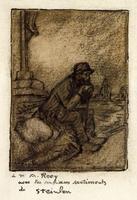
Un Vieux
Theophile Steinlen
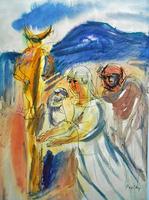
Rilke: The Duino Elegies IV.
Maria Bozoky
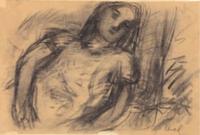
Femme Assoupie
Bela Czobel
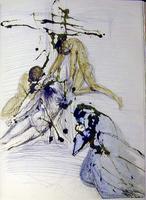
De cruce depositio
Salvador Dali
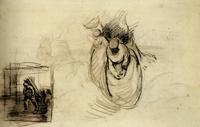
Studies for Figures Carrying Bundles of Wood
Vincent van Gogh
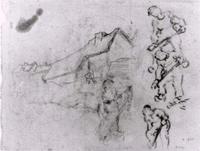
Sketches of a Cottage and Figures
Vincent van Gogh
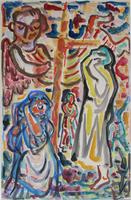
Crucifixion
Rene Portocarrero

Silence
Wilhelm Kotarbinski
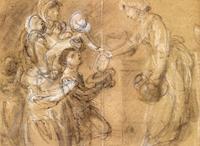
Study For "Charity Relieving Distress"
Thomas Gainsborough
Mocking of Christ
Rembrandt
Tahitians at rest (unfinished)
Paul Gauguin
Jacob shown the Bloodstained Coat of Joseph
Rembrandt
Sheet of Figure Studies
Thomas Sully