Paul Cezanne sanatçısının The Green Pitcher eseri hakkında uzman analizi
Tarz: Post-Impressionism · Tür: still life
Expert Art Historical Analysis: The Green Pitcher by Paul Cézanne
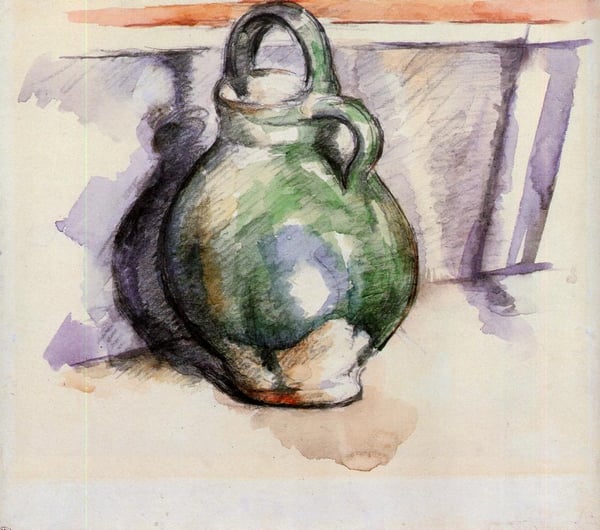
In The Green Pitcher, Paul Cézanne demonstrates the revolutionary principles that define his mature Post-Impressionist still lifes and cement his role as a bridge between 19th-century Impressionism and 20th-century Cubism. Executed during his most structurally rigorous period, this work is significant for its radical departure from traditional perspective and its systematic deconstruction of form through color.
Composition and Spatial Innovation
Cézanne deliberately destabilizes the viewer’s single-point perspective. The tabletop appears tilted upward, the pitcher’s elliptical opening is slightly misaligned with its base, and the surrounding fruit—likely apples or pears—are rendered with multiple, shifting outlines. This “multiple viewpoint” technique, where an object is seen from several angles simultaneously, prefigures the faceted space of Cubism. The green pitcher itself is not a smooth, reflective cylinder; its contours are built from discrete, hatched strokes of green, blue, and yellow, creating a solidity that is simultaneously flattened and volumetric.
Color as Structure
Cézanne famously advised that one should “treat nature by the cylinder, the sphere, the cone.” Here, the green pitcher is modeled not through chiaroscuro (light and shadow) but through modulation—a subtle shift from cool greens to warm ochres and blues applied in parallel, directional strokes. This method gives the object a tangible mass while preserving the canvas’s two-dimensional integrity. The complementary relationship between the green pitcher and the red accents in the fruit activates the entire color field, making color the primary driver of form rather than an afterthought.
Significance within Post-Impressionism and Modern Art
The Green Pitcher is exemplary of Cézanne’s mature style, in which still life became a laboratory for rethinking perception. Unlike the Impressionists, who captured fleeting light, Cézanne sought the underlying geometry beneath nature. This quest for a “constructive stroke” directly inspired Picasso and Braque’s Analytical Cubism (circa 1908–1912). The painting also challenges the hierarchy of genres: Cézanne elevates a humble pitcher and everyday fruit into a monumental, almost architectural composition, stripping away anecdotal detail to focus on the pure relationships of form, color, and space.
Legacy
As one of the most influential still lifes of the late 19th century, The Green Pitcher encapsulates Cézanne’s belief that “painting from nature is not copying the object; it is realizing one’s sensations.” It remains a touchstone for understanding how Post-Impressionism moved beyond visual imitation toward a conceptual, structural art—a shift that would fundamentally alter the course of modern painting.
Museum / Gallery
Görsel olarak benzer
İlişkili kompozisyon ve renk paletine sahip 20 eser
Pots
Petros Malayan
Still Life with Pots
Petros Malayan
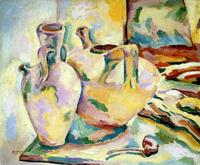
Still Life with Jugs and Pipe
Georges Braque
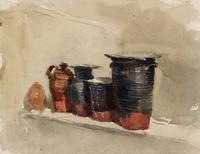
Still Life
David Cox
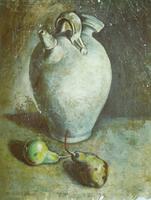
Jug
Salvador Dali
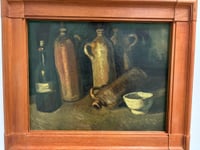
Stilleven met kruiken
Vincent van Gogh
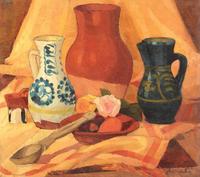
Still Life with Vases and Roses
Francisc Sirato
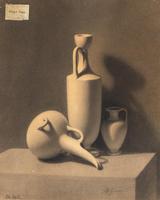
Two Still Lives
Lili Elbe
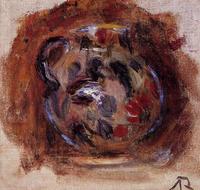
Earthenware Jug
Pierre-Auguste Renoir
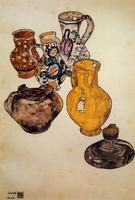
Ceramics
Egon Schiele
Apples, Jug, Iridescent Glass
Paul Gauguin
Still Life (detail)
Niko Pirosmani
White Vase
Avigdor Arikha
Still life with (Buksa) from Darfur
Iman Shaggag
Still Life with Goblet
Juan Gris
Still Life with Four Stone Bottles, Flask and White Cup
Vincent van Gogh
The Studio (I)
Georges Braque
Peasants Jug
Egon Schiele
Still Life
Pieter Wenning
Still Life with Two Pots
Alexandru Ciucurencu