Analisi esperta di The Park of the Chateau Noir with Well di Paul Cezanne
Stile: Cubism · Genere: landscape
Expert Analysis of "The Park of the Chateau Noir with Well" by Paul Cézanne (Final Period)
This landscape, executed during Cézanne’s final period (roughly 1895–1906), stands as a pivotal bridge between Post-Impressionism and early Cubism. Though the artwork is classified under the Cubism style, it is more accurately a proto-Cubist work—Cézanne’s late paintings directly inspired Picasso and Braque’s revolutionary break with perspective.
Significance within Style and Period
-
Geometric Simplification & Multiple Viewpoints
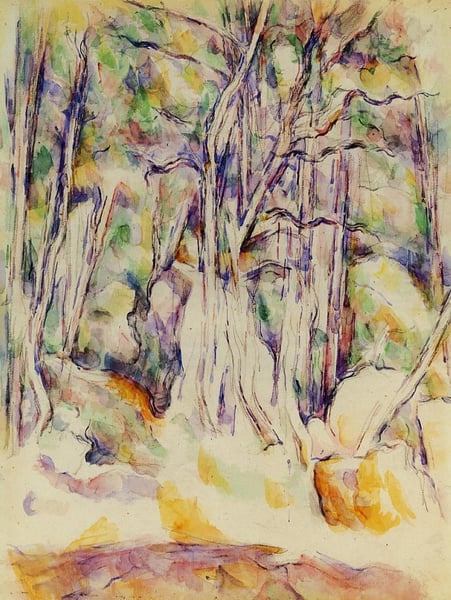
Cézanne reduces the park’s forms—trees, the well, foliage, and architecture—to cylinders, spheres, and cones. In The Park of the Chateau Noir with Well, the well itself is rendered as a series of faceted planes, and the surrounding trees are built from stacked, angled brushstrokes. This flattening of space and simultaneous shifting of vantage points (looking down at the well, straight on at the trees, and upward at the sky) anticipates the fractured perspective that defines Cubism a decade later. -
Color as Structure
Unlike Impressionist color, which sought atmospheric effects, Cézanne uses color modulations—cool blues and greens against warm ochres and earth tones—to model volume and create depth without traditional chiaroscuro. Each stroke of paint functions as a small planar facet, constructing the scene’s solidity through hue and saturation. This technique directly influenced the analytical Cubist palette of Picasso and Braque, who similarly built form with color alone. -
The Final Period’s Monumentality
In his last years, Cézanne worked obsessively on the motif of the Château Noir estate near Aix-en-Provence. The dense, almost claustrophobic composition—dominated by interlocking tree trunks, branches, and the well’s masonry—reflects his growing abstraction. The painting feels simultaneously unfinished and complete: patches of raw canvas or thin washes of paint coexist with thickly layered passages, emphasizing process over illusion. This tension between representation and abstraction is a hallmark of his late style and a direct precursor to Cubism’s dismantling of naturalistic space.
Why It Matters
The Park of the Chateau Noir with Well is significant not because it is a fully realized Cubist painting, but because it demonstrates the collapse of Renaissance perspective into a new pictorial logic. Cézanne’s insistence on “treating nature by the cylinder, the sphere, the cone” gave later Cubists the formal vocabulary to shatter the single viewpoint completely. This work encapsulates the moment when landscape painting ceased to be a window onto the world and became a self-contained construction of planes and color—a foundational step toward modernism.
Museum / Gallery
Visivamente simili
20 opere con composizione e palette affini
In the Woods
Paul Cezanne
Oak tree
Pyotr Konchalovsky
Blue Ravine
Albert Bloch
Boulogne Wood
Berthe Morisot
Trees
Paul Cezanne
Woodland with Boulders
Paul Cezanne
Bela Czobel, Forest
Bela Czobel
Broken Birch
Ivan Shishkin
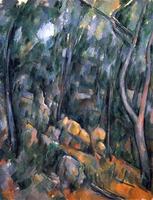
Forest near the rocky caves above the Chateau Noir
Paul Cezanne
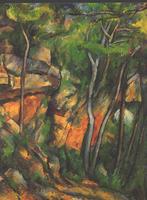
In the Park of the Chateau Noir
Paul Cezanne
Le Carrefour De Malabry
Henri Matisse
Chestnut trees in the autumn in Antagnes, Switzerland
Hubertine Heijermans
Rocks at Fountainebleau
Paul Cezanne
Under the Trees - Monhegan
Robert Henri
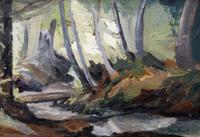
Forest
Georgi Mashev
River Tone, Somerset
Frances Hodgkins
Landscape of Royat, study of trees
Camille Corot
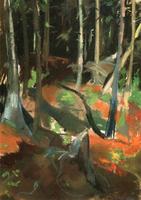
Monhegan, Maine
Robert Henri
Uma pequena queda de água, Raiva
Paulo Fontes
Woods in Autumn
Jack Bush