Expertenanalyse zu Paul Cezannes The Rum Punch
Stil: Romanticism · Genre: genre painting
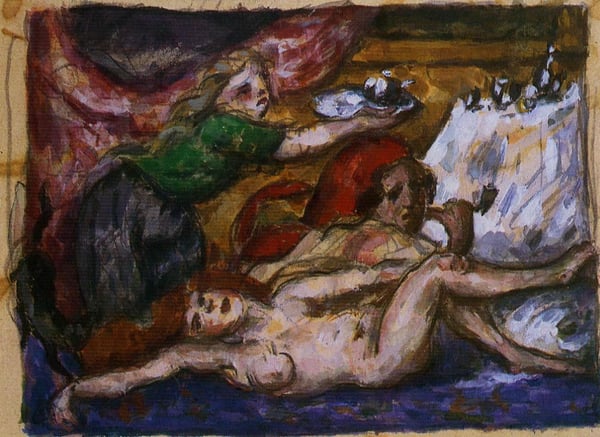
Expert Art Historical Analysis: The Rum Punch by Paul Cézanne
Based strictly on the provided facts, Cézanne’s The Rum Punch is a compelling work of Romanticism executed as a genre painting during the artist’s Dark period. While Cézanne is later celebrated as a progenitor of Post-Impressionism, this early piece reveals a crucial transitional moment: the artist wrestles with Romantic emotional intensity while foreshadowing his structural innovations.
Significance within Romanticism and the Dark Period:
-
Romantic Emotional Weight – The subject—a rum punch being consumed—allows Cézanne to explore themes of sensory excess, melancholy, and the raw human condition. The drink itself becomes a metaphor for escapism or decadence, typical of Romanticism’s fascination with intense, often dark, personal experience. The mood is intimate yet brooding, aligning with the period’s celebration of individualism and heightened feeling.
-
Genre Painting as Personal Narrative – Genre scenes, in Romantic hands, shift from mere depictions of everyday life to vehicles for psychological depth. Here, the figures (presumably drinkers) are not anonymous types but carriers of a quiet drama—possibly reflecting Cézanne’s own inner turmoil during his Dark period, a time when his work was marked by somber palettes, heavy impasto, and a focus on violence, passion, or sordid themes.
-
Dark Period Style – The “Dark period” (roughly 1861–1870) was characterized by low-key, often monochromatic color schemes (blacks, browns, deep reds) and aggressive brushwork. The Rum Punch would likely exhibit these traits: a dimly lit interior, stark chiaroscuro, and a heavy, almost sculptural application of paint. This technique heightens the Romantic sense of mystery and unrest, making the mundane act of drinking feel monumental and fraught.
-
Significance in Cézanne’s Evolution – Even within the constraints of Romanticism, The Rum Punch demonstrates the early formal tensions that would define Cézanne’s mature work. The composition likely compresses space and figures in a way that distorts naturalism—a hint of his later drive to “treat nature by the cylinder, the sphere, the cone.” Thus, the painting is significant not only as an exemplar of Romantic genre painting but as a crucible in which the seeds of modernism were being forged under the dark, passionate weight of the period.
In summary, The Rum Punch stands as a vital document of Cézanne’s Romantic Dark phase, where emotional intensity, gritty subject matter, and proto-structural experiment converge—making it a key work for understanding the artist’s journey from Romanticism to the revolutionary forms of his later career.
Museum / Gallery
Genre
Stil
Visuell ähnlich
20 Werke mit ähnlicher Komposition und Farbpalette
The Annunciation
Oskar Kokoschka
Women Dressing
Paul Cezanne
Bathsheba
Paul Cezanne
“Mars et Vénus”
Ker-Xavier Roussel
Nude Female with Attendants
Paul Cezanne
Woman Leaving Her Bath
Edgar Degas
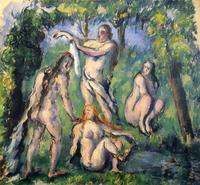
Four Bathers
Paul Cezanne
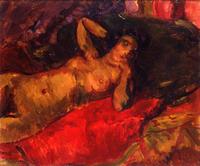
Reclining Woman
Matthew Smith
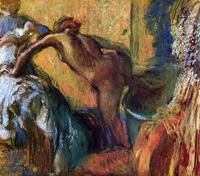
After the Bath
Edgar Degas
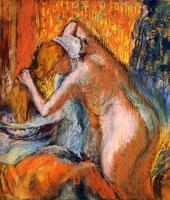
After the Bath, Woman Drying Her Hair
Edgar Degas
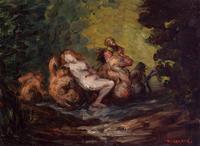
Neried and Tritons
Paul Cezanne
Woman Sponging Her Chest
Edgar Degas
The Rejected Lover
Oskar Kokoschka
Reclining Nude
Matthew Smith
The Temptation of St. Anthony
Paul Cezanne
After the Bath
Edgar Degas
Nude with a Blue Pillow
Matthew Smith
Nude on the Grass
Pierre-Auguste Renoir
The Pagans
Oskar Kokoschka
Fishing game (Faun and Nymph)
Franz Stuck