Expertenanalyse zu Paul Cezannes Tulips in a Vase
Stil: Post-Impressionism · Genre: still life
This analysis is based solely on the provided facts.
Artwork: Tulips in a Vase
Artist: Paul Cézanne
Style: Post-Impressionism
Genre: Still Life
Period: Final Period
Expert Analysis
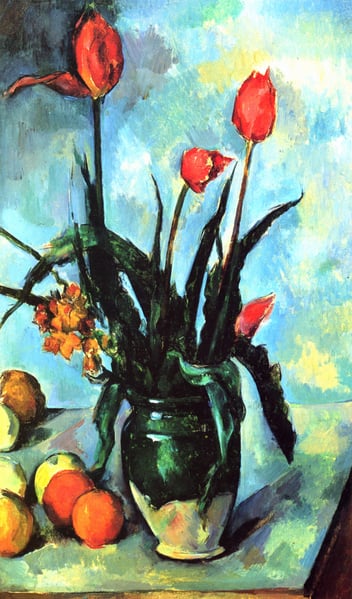
Tulips in a Vase belongs to Paul Cézanne’s final period, the phase in which his Post-Impressionist vision reached its most radical and influential maturity. As a still life from this era, the work epitomizes Cézanne’s lifelong project to reconcile rigorous structure with the vibrancy of sensory experience—a goal that set him apart from the fleeting effects favored by Impressionism and made him a key bridge to early modernism.
Within the Post-Impressionist style, Cézanne’s late still lifes are celebrated for their deliberate distortion of perspective and their construction of form through patches of modulated color. In Tulips in a Vase, the subject—a simple floral arrangement—allows him to reduce natural shapes to their essential geometric cores: the vase becomes a cylinder, the tulips are built from faceted planes of red, yellow, and green. The tabletop tilts upward, defying traditional single-point perspective and compressing space into a shallow, almost tactile field. This compression, typical of his final period, forces the viewer to read the composition as a series of interlocking color relationships rather than as a literal window onto a room.
What makes this work significant within its period is its demonstration of Cézanne’s “constructive stroke”—short, parallel brushmarks that build form through color alone, without relying on line or chiaroscuro. The tulips are not modeled from dark to light; instead, warm hues advance and cool hues recede, creating volume through chromatic contrast. This method anticipates the analytical approaches of Cubism, which Cézanne’s late still lifes directly inspired. The final period is also marked by a newfound freedom: edges are left open, backgrounds are simplified to abstract fields, and the artist’s hand remains visible, emphasizing painting as a process of searching rather than finishing.
In Tulips in a Vase, the ordinary becomes monumental. Cézanne transforms a domestic still life into a study of visual harmony, where every petal and leaf participates in an overall rhythm that balances stability (the vase’s vertical axis) with dynamism (the splayed tulip heads). This tension between order and flux is the hallmark of his final style and the reason his still lifes of this period are considered foundational to the development of 20th-century art.
Museum / Gallery
Visuell ähnlich
20 Werke mit ähnlicher Komposition und Farbpalette
Tulips
Samuel Peploe
Tulips in a Brown Jar
Samuel Peploe
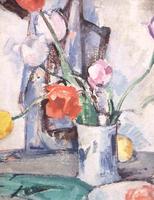
Flowers
Samuel Peploe
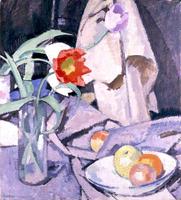
Tulips
Samuel Peploe
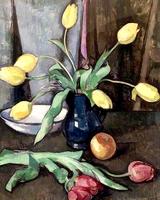
Still Life with Tulips
Samuel Peploe
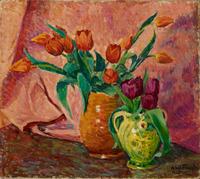
Two Vases with Tulips
Alfred William Finch
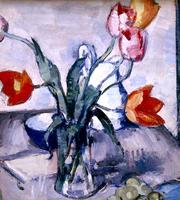
Tulips
Samuel Peploe
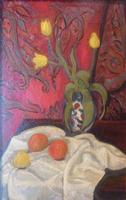
Yellow tulips
Roger de La Fresnaye
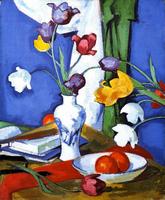
Tulips and Fruit
Samuel Peploe
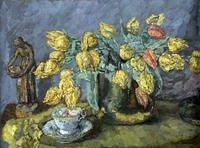
Tulips
Igor Grabar
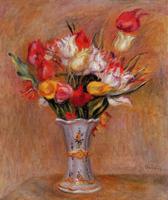
Tulips
Pierre-Auguste Renoir
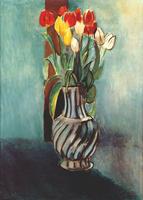
Me, Myself & Stendhal Vase of Tulips
Henri Matisse
Tulips
Jack Bush
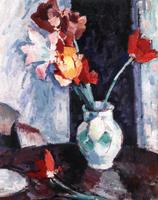
Tulips in a White Vase
Samuel Peploe
Tulipes
Michel Simonidy
Lemons, Apples and Tulips
Henri Fantin-Latour
Bowl of Tulips
Florine Stettheimer
Vase with Tulips
Willy Schlobach
Lalele
Francisc Sirato
Vase of Tulips
Claude Monet