Analisi esperta di View of Gardanne di Paul Cezanne
Stile: Post-Impressionism · Genere: cityscape
Expert Analysis: "View of Gardanne" by Paul Cézanne
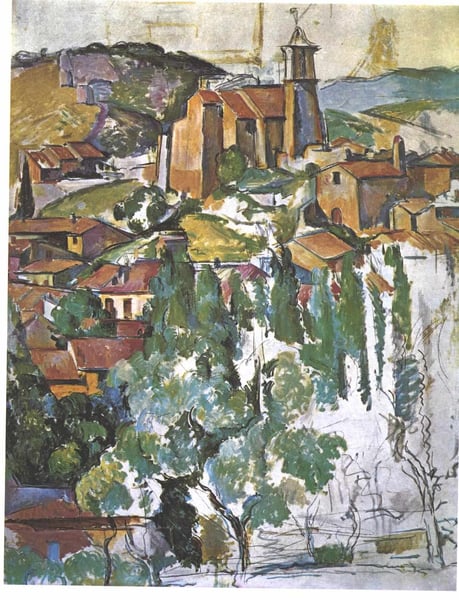
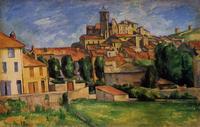
Painted during Cézanne’s mature period, View of Gardanne exemplifies the artist’s profound shift away from Impressionist spontaneity toward the structural, analytical approach that defines Post-Impressionism. As a cityscape, the work is not merely a topographical record but a deliberate study of form, volume, and spatial relationships—the very concerns that would later catalyze Cubism.
Significance and Key Features:
- Geometric Reduction: Cézanne reduces the Provençal town of Gardanne into a series of interlocking cubes, cylinders, and planes. The cluster of houses, terraced hillsides, and the church spire are built from broad, faceted brushstrokes, anticipating the fragmented geometries of Picasso and Braque.
- Color as Structure: Instead of modeling with traditional chiaroscuro, Cézanne uses modulated patches of warm ochres, cool blues, and muted greens to create depth. This “constructive stroke” gives the canvas a tactile, almost masonry-like density, unifying the sky, architecture, and landscape into a single pictorial fabric.
- Dynamic Perspective: The scene is compressed and tilted slightly upward, collapsing foreground and distance. This flattened, ambiguous space—where the road seems to slide upward and the buildings lean—challenges Renaissance perspective, making the viewer aware of the painting’s two-dimensional surface while still suggesting deep recession.
- Mature Synthesis: This work sits at the heart of Cézanne’s mature period (c. 1885–1906), where he abandoned the loose brushwork of his early career for a disciplined, deliberate process. Each stroke is a decision, building form through juxtaposed color patches. The result is a cityscape that feels simultaneously solid and vibrating—a tension between permanence and optical sensation.
Why It Matters: View of Gardanne is a pivotal document of Post-Impressionism’s mission to push beyond naturalism. Cézanne treats the town not as a charming vignette but as a problem of perception—how can three-dimensional experience be translated onto a flat canvas without losing coherence? His solution—using color and touch to create volume, rather than line and shadow—directly influenced the development of Fauvism, Expressionism, and ultimately, Cubism. In this modest cityscape, we see the seeds of modern art’s formal revolution.
Museum / Gallery
Genere
Stile
Visivamente simili
20 opere con composizione e palette affini
Gardanne
Paul Cezanne
Siena
Pyotr Konchalovsky
Ile de France Landscape
Paul Cezanne
Mirmande
André Lhote
Landscape
Spyros Papaloukas
View from Karyes of Mount Athos
Spyros Papaloukas
Watch Tower near Santa Guiliana
William Balthazar Rose
Vanha Cagnes
Sallinen Tyko
Abbey Koutloumousiou
Spyros Papaloukas
Cassis. The view from the window.
Pyotr Konchalovsky
Gardanne (Horizontal View)
Paul Cezanne
Landscape, Southern France
Amedeo Modigliani
Cassis
Samuel Peploe
Sketch for 'Sanary, France'
Rupert Bunny
Ceret Lanscape
Chaim Soutine
Siena
Pyotr Konchalovsky
The Aventine from the Palatine
Walter Crane
Czóbel Béla Cagnes Sur Mer
Bela Czobel
Vue De Collioure
Henri Matisse
View of the Fortified Village of Eze
Winston Churchill