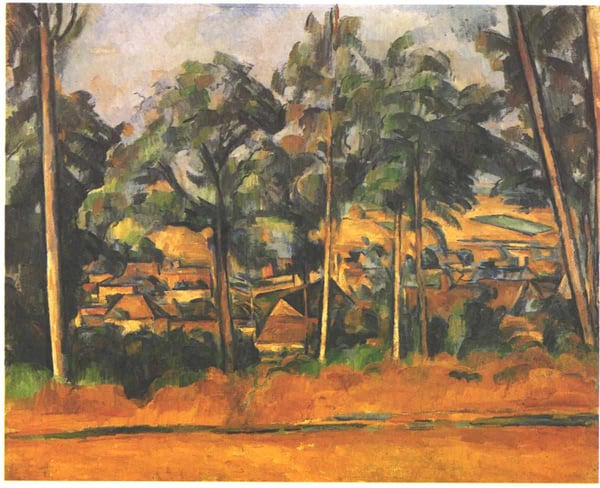
Analisi esperta di Village in the Provence di Paul Cezanne
Stile: Post-Impressionism · Genere: landscape
Analysis of "Village in the Provence" by Paul Cézanne
As a Post-Impressionist landscape, Cézanne’s “Village in the Provence” stands as a pivotal bridge between 19th-century Impressionism and the radical formal experiments of the 20th century. The work’s significance lies in how Cézanne reimagines the landscape genre: rather than capturing fleeting atmospheric effects, he builds the scene through deliberate, faceted brushstrokes that emphasize geometric structure—cylindrical trees, cubic houses, and planar hillsides. This analytical approach to form anticipates Cubism and directly influenced artists like Picasso and Braque. The composition treats the Provençal village not as a picturesque subject but as a rigorous study in color modulation and spatial tension, where warm ochres and cool blues create a palpable sense of depth without relying on traditional linear perspective. The painting embodies Cézanne’s dictum to “treat nature by the cylinder, the sphere, the cone,” making it a foundational statement of Post-Impressionism’s shift toward subjective structure and optical complexity.
Visivamente simili
20 opere con composizione e palette affini
Edge of the Forest
Henry Ossawa Tanner
The valley of the Oise
Paul Cezanne
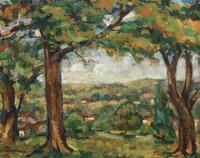
Landscape from Argeș
Nicolae Darascu
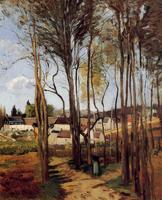
A Village through the Trees
Camille Pissarro
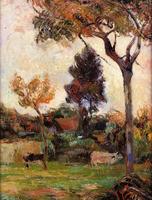
Two cows in the meadow
Paul Gauguin
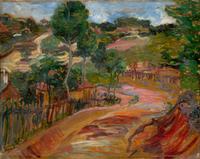
Resnik
Nadezda Petrovic
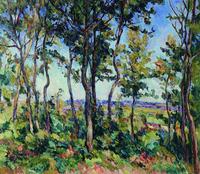
Young oaks
Pyotr Konchalovsky
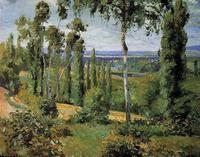
The Countryside in the Vicinity of Conflans Saint Honorine
Camille Pissarro
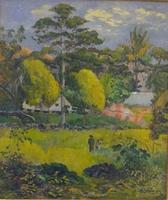
Paysage, Ou Promenade Familiale
Paul Gauguin
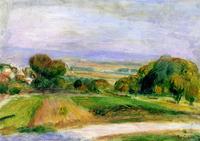
Landscape
Pierre-Auguste Renoir
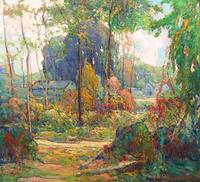
Autumn Design
Charles Reiffel
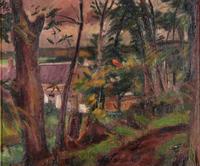
Village forestier Grosrouvre
Henri Le Fauconnier
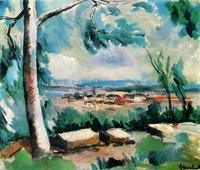
The Village
Maurice de Vlaminck
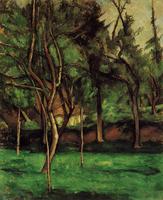
Orchard
Paul Cezanne
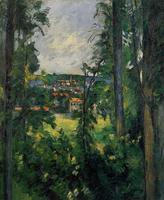
Auvers. View from Nearby
Paul Cezanne
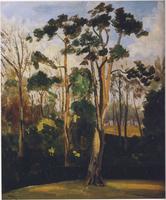
Woods at Mimizan
Winston Churchill
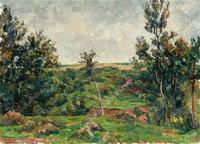
Rainy day
Pyotr Konchalovsky
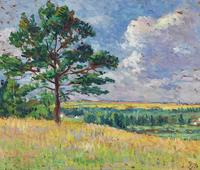
Paysage près de Méréville
Maximilien Luce
New England Birches
Ernest Lawson
Trees near Breccles
Winston Churchill