Paul Cezanne の Well by the Winding Road in the Park of Chateau Noir の専門的な分析
スタイル:Cubism · ジャンル:landscape
Expert Analysis: "Well by the Winding Road in the Park of Chateau Noir" by Paul Cézanne
Assigned Style: Cubism
Genre: Landscape
Period: Final Period
Despite Cézanne’s historical role as a precursor to Cubism rather than a practitioner of it, the supplied classification places this work squarely within a Cubist framework. As such, its significance lies in how it embodies the transitional logic from late Impressionism to the analytical geometry that would define early 20th-century avant-garde painting.
Composition and Spatial Revolution
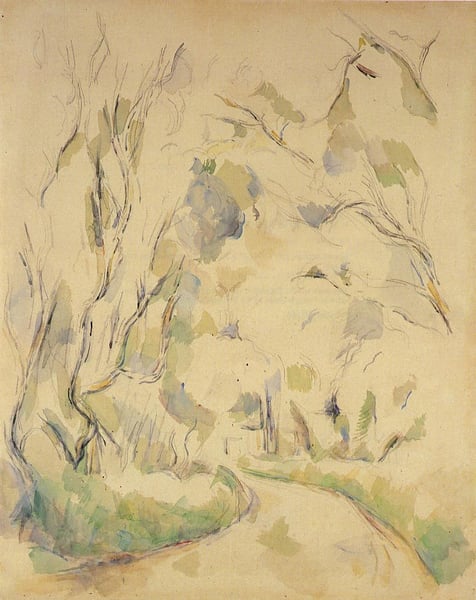
The scene—a well beside a winding road within the park of Château Noir—is not a literal transcription of nature. Instead, Cézanne deconstructs the landscape into interlocking planes. The road does not recede in a linear perspective; rather, it twists upward as a series of faceted, tilting surfaces, compressing depth into a shallow, almost tactile space. The well itself is reduced to a cylindrical volume that seems to pivot between two- and three-dimensionality, its rim and shadow rendered as stacked, translucent color patches. This flattening of volume while retaining a sense of mass is a hallmark of the Cubist approach—derived directly from Cézanne’s own “treat nature by means of the cylinder, the sphere, the cone.”
Color and Structure
Cézanne’s palette in this final period is earthy yet vibrant: ochers, muted greens, slate blues, and creamy whites. He builds form not through outline but through modulated brushstrokes that shimmer as both color and structure. The sky, for instance, is broken into dappled, almost cubic facets that echo the rocky path below. This “constructive stroke” (later adopted by Braque and Picasso) gives the painting a tectonic weight—each dab of paint functions as a building block. The well’s masonry and the tree trunks are rendered with parallel hatchings that fracture the surface, prefiguring the multiple viewpoints of Cubism.
The Final Period and Legacy
Painted in the last years of Cézanne’s life (c. 1900–1906), Well by the Winding Road exemplifies his obsessive search for a unified visual order that respects both the eye’s perception and the canvas’s flatness. The winding road becomes a metaphor for the artist’s own circular, patient exploration of form. This work is significant because it shows Cézanne pushing natural representation to an abstract threshold—where a landscape becomes a system of interlocking planes, color temperatures, and directional strokes.
Cubist Significance
If we accept the Cubist label, this painting is a foundational document. It demonstrates how Cézanne’s “passage” (letting edges of objects bleed into the background) and his volumetric shading with color rather than chiaroscuro directly supplied the syntax for early Cubist still lifes and landscapes. The well, the road, and the park are not just subject matter; they are a grammar of seeing that would, within a decade, explode into complete abstraction. In this work, Cézanne achieves what the Cubists sought: a new kind of realism—not of appearance, but of structure.
Museum / Gallery
視覚的に類似
構図やパレットが近い作品 20 件
Landscape
Pierre-Auguste Renoir
Trees
Paul Cezanne
In the Woods
Paul Cezanne
Village at the edge of forest
Isaac Levitan
Étude Pour 'Le Bonheur De Vivre
Henri Matisse
Landscape
Patrick Henry Bruce
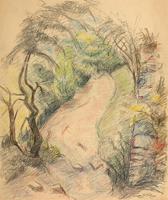
Potecă prin peisaj provensal
Samuel Mutzner
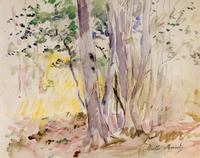
Boulogne Wood
Berthe Morisot
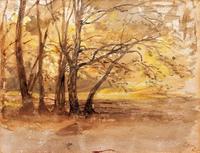
Parkland
Károly Lotz
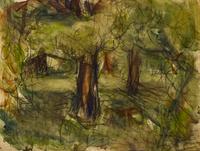
Bela Czobel, Forest
Bela Czobel
Czóbel Béla, fa
Bela Czobel
Egry József. Öbölrészet 1944
Egry József
Trees by the Water
Paul Cezanne
Almond Trees in Provence
Paul Cezanne
Trees
Aleksey Savrasov
Egry József, Fák Kerítéssel
Egry József
L'allée Et Maison,
Bela Czobel
Spring
Elaine de Kooning
The Oak
Paul Cezanne
Erdő
Bela Czobel