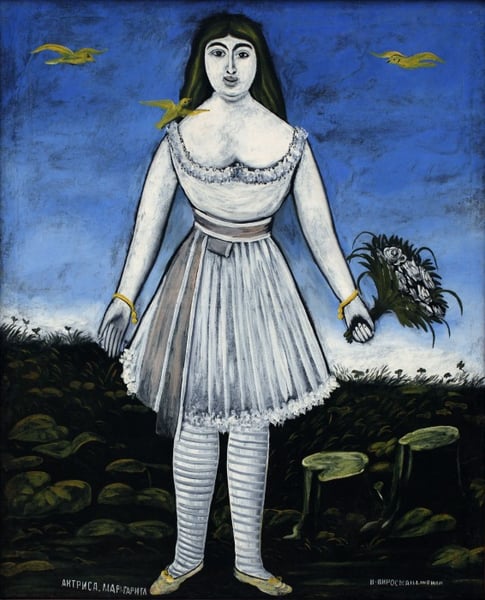
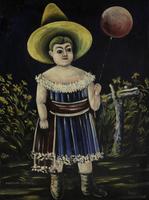
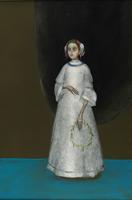
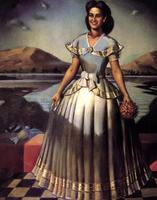
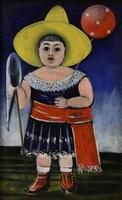
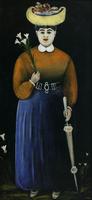
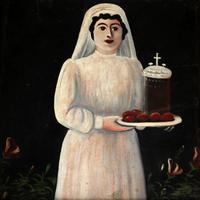
Niko Pirosmani’s Actress Margaret stands as a poignant emblem of Naïve Art, where raw emotional sincerity overrides academic polish. Painted in the early 20th century, it depicts the French actress Marguerite de Sèvres—the object of Pirosmani’s unrequited love, for whom he reportedly sold everything to buy flowers. The portrait’s significance lies in its stark, frontal simplicity: a dark, flat background isolates the figure, while bold outlines and a restrained palette emphasize her contemplative stillness. This is not a study in sophisticated perspective or chiaroscuro; instead, Pirosmani’s direct, almost icon-like rendering conveys an intimate, haunting presence. Within Primitivism, the work exemplifies the movement’s rejection of formal training—a quality that later inspired the Russian avant-garde, including artists like Malevich and Larionov, who saw in Pirosmani a purity of vision. The painting is thus both a personal testament and a key artifact of how Naïve Art challenged hierarchical notions of skill, proving that profound emotional truth can emerge from the simplest means.