Pavel Filonov sanatçısının Execution (After 1905) eseri hakkında uzman analizi
Tarz: Analytical Realism · Tür: allegorical painting
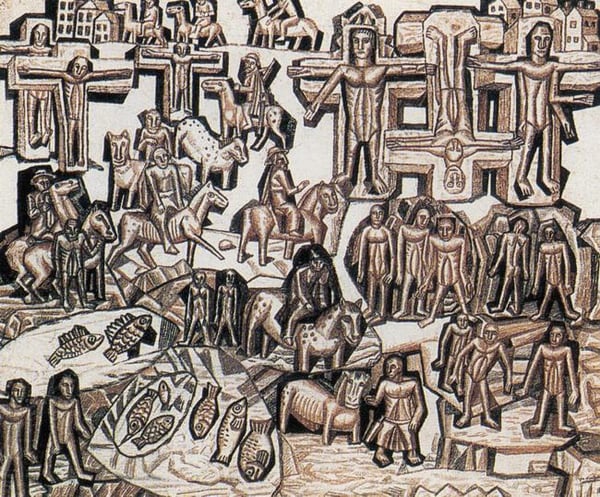
Pavel Filonov’s “Execution (After 1905)” stands as a pivotal work within his self-defined style of Analytical Realism and functions as a potent allegorical painting that reimagines historical trauma. The artwork’s significance lies in how Filonov transforms the concrete event of the 1905 Russian Revolution—a massacre of peaceful protesters—into a dense, cosmic allegory of suffering and rebirth, rejecting conventional narrative for a fractured, crystalline visual language.
Within the context of Analytical Realism, Filonov moved beyond mere depiction. He treated each inch of the canvas as a living organism, building form from the smallest, most intense brushstrokes—what he called “made paintings.” In Execution, this method creates a surface that seems to pulse with raw energy: bodies, buildings, and abstracted organic shapes are merged into a single, agitated field. The allegorical genre allows Filonov to avoid a straightforward documentary approach; instead, the execution becomes a universal symbol of state violence, with human figures dissolving into a web of neural-like lines and sharp, faceted planes that suggest both physical and psychic fragmentation.
The significance of this work within its period is profound. While contemporaries like Malevich or Kandinsky moved toward pure abstraction or spiritual geometries, Filonov’s Analytical Realism insisted on embedding the political and the visceral directly into the painting’s molecular structure. Execution (After 1905) thus represents a radical synthesis: a historical allegory rendered through a painstakingly analytical process, where every microscopic decision contributes to an overwhelming, almost claustrophobic sense of collective memory. It remains a haunting testament to Filonov’s belief that art must be “intensive”—that the artist’s duty is to see beyond surface realities into the fundamental, often brutal, structures that bind matter and history.
Görsel olarak benzer
İlişkili kompozisyon ve renk paletine sahip 20 eser
Girl with a Flower
Pavel Filonov
Hell
Herrad of Landsberg
Change of Residence
Paul Gauguin
Mufangejo's Kraal
John Muafangejo
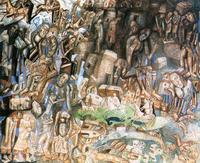
Untitled (The Riders)
Pavel Filonov
Untitled
Jackson Pollock
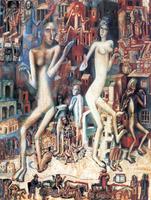
Man and Woman (Adam and Eve)
Pavel Filonov
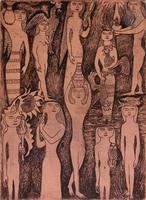
Illustration for The Ancient Egyptian Book of the Dead
Anton Prinner
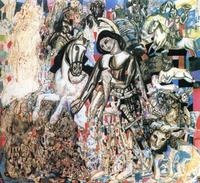
Untitled (St. George the Victorious)
Pavel Filonov
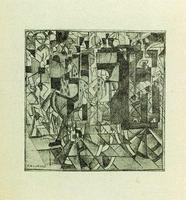
The crew on the move
Kazimir Malevich
Figural Composition
Walter Battiss
Late Night Dreams
Salvador Dali
Bortnyik Sándor, Figuren Komposition Und Pferder
Sandor Bortnyik
Those Who Have Nothing to Lose
Pavel Filonov
Les boxeurs
Francois Arnal
Noah and the Rainbow
Marc Chagall
Herdman Philipus Kaluvi was died in 1982
John Muafangejo
After the Raid
Pavel Filonov
Magi
Pavel Filonov
The abolition of slavery
Marcel Gromaire