Expert analysis of Pavel Filonov’s Two Men
Style: Analytical Realism · Genre: genre painting
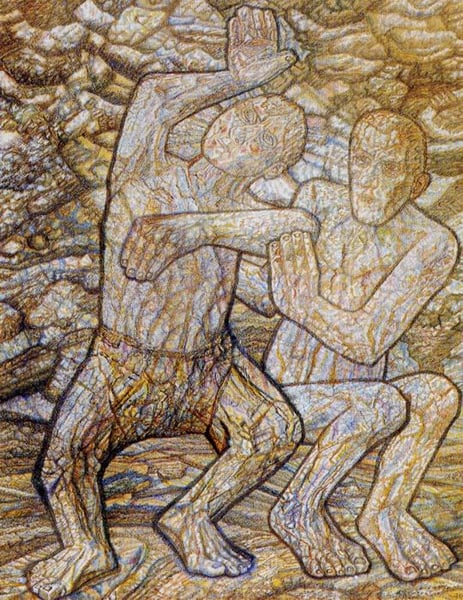
Pavel Filonov’s Two Men exemplifies the radical visual language of Analytical Realism, a style he pioneered in the early 20th century. Unlike conventional genre painting, which seeks to depict everyday life with naturalistic clarity, Filonov’s approach atomizes form into a dense, crystalline structure of interlocking planes, lines, and color patches. The work’s significance lies in its embodiment of Filonov’s core principle: “making painting” as an analytical process. Instead of reproducing the surface appearance of two figures, he breaks down their bodies and surroundings into a pulsating, almost biological web of shapes, suggesting that reality is a dynamic, organic system rather than a static scene.
Within the context of the Russian avant-garde, Two Men stands as a rejection of both pure abstraction and traditional representation. Filonov insisted that art must reveal the “inner structure” of phenomena—the unseen forces and relationships beneath visible forms. Here, the genre setting (two men, perhaps workers or anonymous figures) becomes a vehicle for metaphysical inquiry: the figures emerge from and dissolve back into the painterly field, embodying Filonov’s belief in the unity of all matter and consciousness. This work is significant because it transforms an ordinary motif into a dense, immersive experience that demands active perception, prefiguring later developments in process-based and systemic art.
Visually similar
20 works with related composition and palette
The fight
Ossip Zadkine
Lied I
Albert Bloch
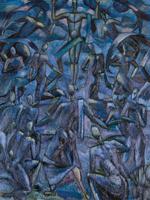
Ascension
Kmetty János
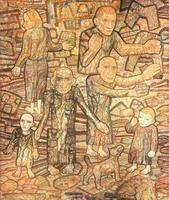
After the Raid
Pavel Filonov
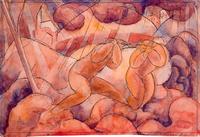
Scherzo
Albert Bloch
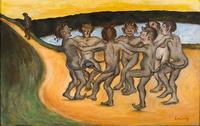
Round Dance
Hugo Simberg
Double Nude: Two Women
Oskar Kokoschka
Composition (A Raid)
Pavel Filonov
Bathers
Paul Cezanne
Loneliness for Two
George Stefanescu
Innocence
Kateryna Lysovenko
Mary Wigman's Dance of the Dead
Ernst Ludwig Kirchner
Rose Caryatid (Audace)
Amedeo Modigliani
Der Tanz (Tanzende und Badende am Waldteich)
Max Pechstein
Study of Women
Ossip Zadkine
Untitled (Infernal figures)
Albert Bloch
Cain and Abel
Dmytro Kavsan
Clash of the Titans
Koloman Moser
The four Pierrots
Albert Bloch
Embracing Colours
George Stefanescu