Analisi esperta di Anthropometry di Yves Klein
Stile: Nouveau Réalisme · Genere: abstract
Expert Analysis of Yves Klein’s Anthropometry
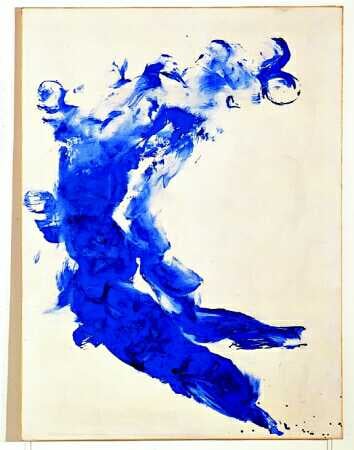
Yves Klein’s Anthropometry (1960) stands as a radical manifesto of the Nouveau Réalisme movement, a French post-war avant-garde style that sought to incorporate reality directly into art. Genre-defined as abstract, the work nonetheless subverts pure abstraction by using the human body as a living stamp, producing indexical traces rather than gestural marks.
Significance within Nouveau Réalisme:
Klein’s “Anthropometries” were not paintings in the traditional sense but ritualistic performances. Directing nude models (his “living brushes”) coated in his patented International Klein Blue (IKB), he pressed their bodies onto canvas to create ghostly, blue silhouettes. This process merged performance, sculpture, and painting, collapsing the boundary between artist, medium, and object. For Nouveau Réalisme—a movement that championed the appropriation of everyday reality (e.g., compressed car parts, torn posters)—Klein’s use of the live body as a tool was a radical, ephemeral act that captured l’imprégnation (the imprint of life itself).
Abstract yet Concretely Human:
Though the resulting compositions are abstract in their flat expanses of blue and biomorphic shapes, they are profoundly figurative in origin. The body’s absence/presence creates a haunting tension: the blue voids evoke emptiness, flesh, and the sublime. Klein’s monochrome IKB—a pure, ultramarine pigment suspended in synthetic resin—lent the work a spiritual, infinite dimension. The Anthropometry series challenged the very definition of painting, asserting that the artist’s role was not to make but to orchestrate the interaction of material, gesture, and space.
Enduring Impact:
Klein’s Anthropometries are pivotal for anticipating performance art, body art, and process art. They elevate Nouveau Réalisme from mere object-based collage to a philosophical inquiry into presence, mortality, and the act of creation itself. The work remains a touchstone for how abstraction can be both utterly pure and viscerally human.
Genere
Stile
Visivamente simili
20 opere con composizione e palette affini
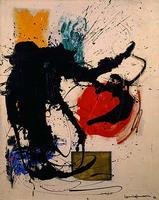
Rope-Swinger
Hans Hofmann
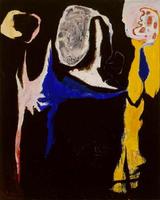
July 1954
Frank Lobdell
Blue Jay
Helen Frankenthaler
I Saw That (#281)
Stephen Mueller
Winter Birch
Ed Clark
Sans titre
Marcelle Loubchansky
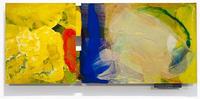
Fog Light
Sam Gilliam
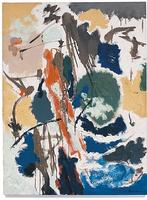
Outdoors
John Ferren
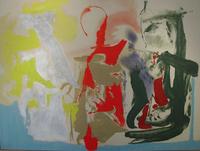
Untitled
Friedel Dzubas
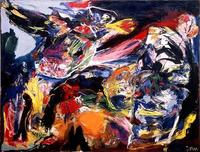
Une mime de rien (ou presque)
Asger Jorn
Illimité cosmique
Jean Miotte
Black Diamond
Hans Hofmann
Variations I on Clark's Cove
Grace Hartigan
Polaris
Friedel Dzubas
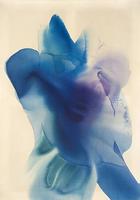
Phenomena Astral Blue
Paul Jenkins
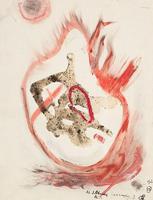
Composition abstraite
Marcelle Loubchansky
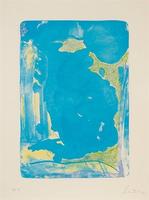
Reflections IV
Helen Frankenthaler
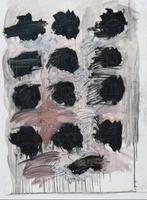
Untitled
Houria Niati
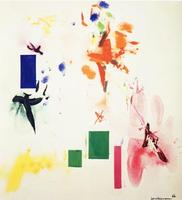
Joy Sparks of the Gods II
Hans Hofmann
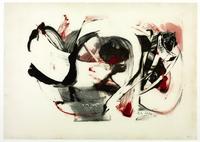
Untitled
Karl Otto Gotz