Analisi esperta di Christ Carrying the Cross di Yves Klein
Stile: Nouveau Réalisme · Genere: religious painting
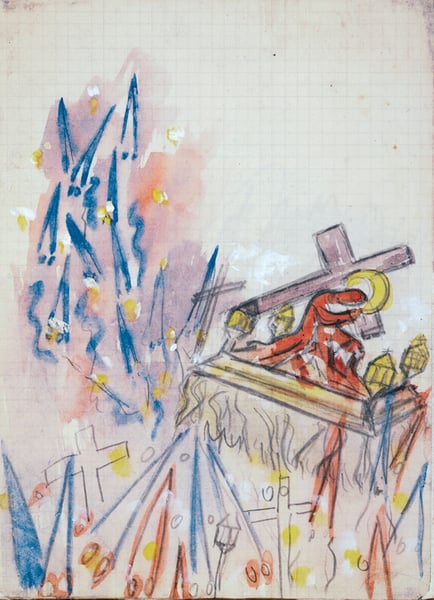
In considering Yves Klein's "Christ Carrying the Cross," the work stands as a pivotal intersection of spiritual ambition and the radical materiality of Nouveau Réalisme. While the genre is religious painting, Klein’s execution subverts centuries of tradition by asserting that the real essence of the sacred lies not in narrative detail, but in the physical and metaphysical presence of pure color and precious substance.
Significance within Nouveau Réalisme:
Klein, a founding figure of Nouveau Réalisme, rejected Abstract Expressionism’s gesture in favor of a "new realism" that sought to capture the real as it is. In this work, he uses his patented International Klein Blue (IKB)—a deep, ultramarine pigment suspended in a synthetic resin to preserve its luminous intensity. For Klein, blue was the vehicle of the infinite—the color of the void and of spiritual transcendence. The painting likely reduces the figure of Christ to a silhouette or an imprint, echoing his Anthropometries (body impressions made by models covered in paint). But here, the body is not just a trace; it is the literal manifestation of Christ’s burden. The cross may be suggested through gold leaf or a simple vertical/horizontal division of the monochrome field, aligning with Nouveau Réalisme’s use of objet trouvé (the raw canvas, the pure pigment) as a means to bypass illusionism.
Spiritual and Conceptual Innovation:
Klein was a Rosicrucian and believed that art could make the immaterial visible. By taking a foundational Christian narrative—the Via Dolorosa—and stripping it to its chromatic and luminous essentials, he performs a radical act: he replaces narrative empathy with direct sensory encounter. The blue is not merely a background; it is the substance of the divine, the very air through which Christ moves. The gold leaf (often used in medieval and Byzantine icons) situates the work within a sacred tradition, but Klein’s application is distinctly modern—flat, non-illustrative, almost commercial in its smoothness. This juxtaposition of the ethereal (IKB) and the opulent (gold) creates a new kind of iconography: one where the real is the pigment itself, and the spiritual is the viewer’s absorption into its hue.
Art-Historical Context:
In an era when Pop Art and Minimalism were emerging, Klein’s religious painting is a defiantly metaphysical gesture. It rejects both the irony of Pop and the detachment of Minimalism, insisting that the highest realism is the unmediated encounter with the transcendent. "Christ Carrying the Cross" thus becomes a threshold: it is at once a relic of Nouveau Réalisme’s experiment with the real, and a prophetic vision of a spirituality rendered through pure color. The work’s significance lies in its ability to make faith tactile—not through depiction, but through the very matter of the canvas. Here, Klein achieves what he called the "total immaterialization" of art: the physical object dissolves into an experience of the infinite.
Visivamente simili
20 opere con composizione e palette affini
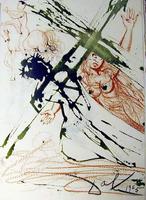
Jesus carrying the cross
Salvador Dali
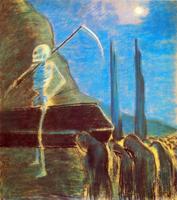
Funeral Symphony (V)
Mikalojus Konstantinas Ciurlionis
The martyr
Marc Chagall
In the cemetery
Kazimir Malevich
Saint-Pierre
Carlos Schwabe
Untitled
Alevtyna Kakhidze
Moses receiving the Tablets of Law
Marc Chagall
Kolner Serie # 14
Maria Bozoky
Golgotha
Romare Bearden
Untitled. Srawberry Andreevna
Alevtyna Kakhidze
First Phase of the Birth of Eroticism Coming from An Unknown Thorn
Lubo Kristek
Moses with the Burning Bush
Marc Chagall
Untitled
Zdzislaw Beksinski
Moses with the Burning Bush
Marc Chagall
Amalie Cleress
Adolf Wölfli
The sacrifice of Isaac
Marc Chagall
Illustration for Cavafy's poem Lovely White Flowers
Yiannis Tsaroychis
The sacrifice of Isaac
Marc Chagall
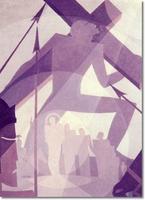
The Crucifixion
Aaron Douglas
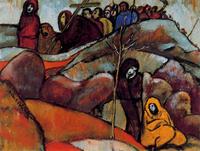
Procession with the Cross
Albert Bloch