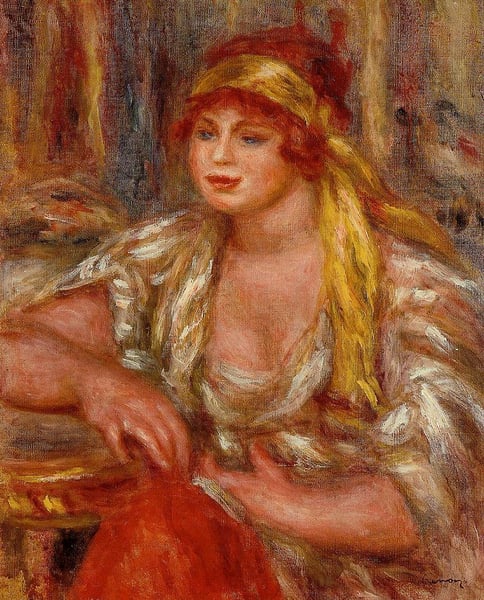
Andree in Yellow Turban and Blue Skirt
Dettagli
Analisi esperta di Andree in Yellow Turban and Blue Skirt di Pierre-Auguste Renoir
Stile: Impressionism · Genere: portrait
Expert Analysis: "Andree in Yellow Turban and Blue Skirt" (c. 1900s) by Pierre-Auguste Renoir
This portrait belongs to Renoir’s Later Years, a period when his Impressionist touch evolved into a more classical, sensuous, and decorative style. Painted in warm, saturated hues, the work showcases Renoir’s lifelong fascination with feminine grace and his shift toward a softer, almost ethereal handling of light and form.
Stylistic Significance:
- Color as form: The bold contrast of the yellow turban and blue skirt demonstrates Renoir’s mastery of complementary colors. Rather than modeling with sharp chiaroscuro, he builds the sitter’s volume through patches of juxtaposed warm and cool tones—a hallmark of Impressionism that he refined in his later years into a more fluid, “roccoco” harmony.
- Brushwork and texture: The turban’s fabric is rendered with quick, feathery strokes that suggest the shimmer of silk, while the face is painted with smoother, blended passages—creating a focal point of soft, idealized beauty. This interplay of loose and refined handling is typical of Renoir’s late portraits, where he sought to capture not just a likeness but a mood of radiant, tranquil femininity.
- Intimacy and idealization: Unlike his earlier, more spontaneous scenes of Parisian life, this portrait is staged and intimate. The model, likely one of Renoir’s favorite sitters (often named “Andrée” or “Andrée Heuschling”), is presented in three-quarter view, her gaze averted in a pensive, serene manner. The background is deliberately vague—a wash of green and gold—to avoid distracting from the figure’s warm presence.
Context within Renoir’s Oeuvre: By the 1900s, Renoir suffered from severe arthritis, yet his late works are paradoxically some of his most optimistic and tactile. Andree in Yellow Turban and Blue Skirt exemplifies his belief that a portrait should convey the “joy of life” through color and sensuous surface. The yellow turban—almost luminous against the mottled background—acts as a halo of light, echoing the religious and classical overtones that Renoir admired in Raphael and Rubens.
Why it matters: This painting bridges Renoir’s Impressionist roots with his later “Ingresque” phase, where line and volume gain prominence. It proves that even in his declining years, Renoir could distill a moment of pure, decorative beauty into a canvas that feels both fleeting and eternal—a testament to his unwavering commitment to the human figure as a vessel for light and emotion.
Museum / Gallery
Visivamente simili
20 opere con composizione e palette affini
Dedee in spanish dress
Pierre-Auguste Renoir
Woman with a Yellow Turban
Pierre-Auguste Renoir
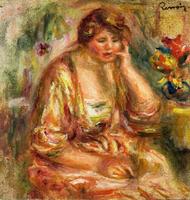
Andree in a Pink Dress
Pierre-Auguste Renoir
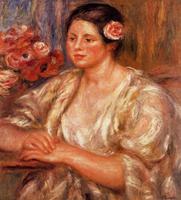
Madelaine in a White Blouse and a Bouquet of Flowers
Pierre-Auguste Renoir
Woman Playing Cards
Pierre-Auguste Renoir
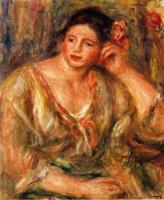
Madeleine Leaning on Her Elbow with Flowers in Her Hair
Pierre-Auguste Renoir
Andree in Blue (Andree Heurschling)
Pierre-Auguste Renoir
Madeline wearing a Rose
Pierre-Auguste Renoir
Model with bare breast
Pierre-Auguste Renoir
Profile of Andre Leaning Over
Pierre-Auguste Renoir
Woman Wearing a Rose Andree
Pierre-Auguste Renoir
Young Woman Seated in an Oriental Costume
Pierre-Auguste Renoir
Woman Leaning on Her Elbow
Pierre-Auguste Renoir
Lucienne
Pierre-Auguste Renoir
Girl looking into a mirror
Pierre-Auguste Renoir
Gabrielle with a Rose
Pierre-Auguste Renoir
Bust of a Young Girl in a Straw Hat
Pierre-Auguste Renoir
Woman in a Straw Hat
Pierre-Auguste Renoir
Woman in a hat with flowers
Pierre-Auguste Renoir
Portrait of Lucienne
Pierre-Auguste Renoir