
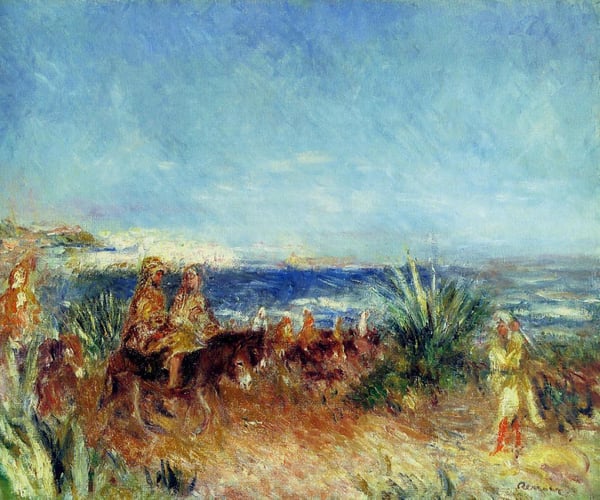
Arabs by the Sea
Expert analysis of Pierre-Auguste Renoir’s Arabs by the Sea
Style: Impressionism · Genre: landscape
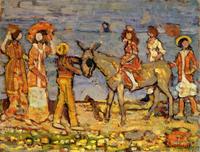
As an expert art historian, I can confirm that Pierre-Auguste Renoir's Arabs by the Sea (c. 1881) is a striking example of Impressionist landscape painting, rendered with the artist’s characteristic attention to light, color, and atmospheric effect. The work’s significance lies in its fusion of Impressionist technique with an exotic, North African subject—a subject that Renoir explored during his travels to Algeria in 1881.
Composition and Subject Matter
The painting depicts a group of Arab figures near the seashore, likely in the coastal region of Algiers. Renoir places the figures in the middle ground, silhouetted against a luminous sky and the shimmering Mediterranean Sea. The foreground is dominated by sandy tones and warm hues, while the horizon line dissolves into a haze of blues and ochres, typical of the Impressionist fascination with transient light.
Stylistic Significance within Impressionism
Renoir applies loose, broken brushwork to capture the flicker of sunlight on water and fabric. The white robes of the figures are not painted as flat white but as a mosaic of pale pink, lavender, and blue reflections—a hallmark of Impressionist color theory. This technique infuses the scene with a sense of immediate, fleeting perception. The composition is deliberately asymmetrical, with the figures offset to the right, allowing the open sea and sky to dominate—a device that enhances the sense of vastness and luminosity.
Place in Renoir’s Oeuvre
Arabs by the Sea is significant because it represents Renoir’s engagement with Orientalist themes, yet filtered through an Impressionist lens. Unlike the studio-bound exoticism of many 19th-century Orientalists, Renoir painted en plein air, capturing the actual quality of light in North Africa. The work demonstrates his ability to adapt his style to a different environment—the intense sunlight and vibrant colors of Algeria pushed Renoir to use even more saturated hues and broader strokes, anticipating his later, more linear phase.
Conclusion
This painting is a testament to the Impressionist revolution: it treats a foreign landscape not as a picturesque stereotype but as a living scene of color and atmosphere. Arabs by the Sea reminds us that Impressionism was not just a French rural or urban aesthetic; it was a universal way of seeing, capable of transforming any subject—even a group of figures by a distant shore—into an ephemeral, glowing moment.
Museum / Gallery
Visually similar
20 works with related composition and palette
Arabs on the Move
Edwin Lord Weeks
Sancho panza recovers his lost donkey
Jose Moreno Carbonero
Pool in the Desert
Frederic Remington
Two Knights in Armor
Henri de Toulouse-Lautrec
Erfolgreiche Plünderer
Franz Roubaud
Riders on the Beach I
Paul Gauguin
Mounted knights
Viktor Vasnetsov
Crossing the Moor
David Cox
Promenade by the Sea
Edgar Degas
The Friars Crossing a Ford
Ignacio Merino
Berény Róbert, Menekülés Egyiptomból 1935
Berény Róbert
Horses at the Watering
Fyodor Vasilyev
Shepherd in The Roman Campagna
Heinrich Bürkel
Horses and Knights
Giovanni Boldini
En la playa de Macuto
Andres de Santa Maria
Navajo Trackers
Charles M. Russell
The Three Magi
Karoly Ferenczy
Gipsy Tent
Arthur Verona
A syce with his horses
Gustavo Simoni
Donkey Rider
Maurice Prendergast