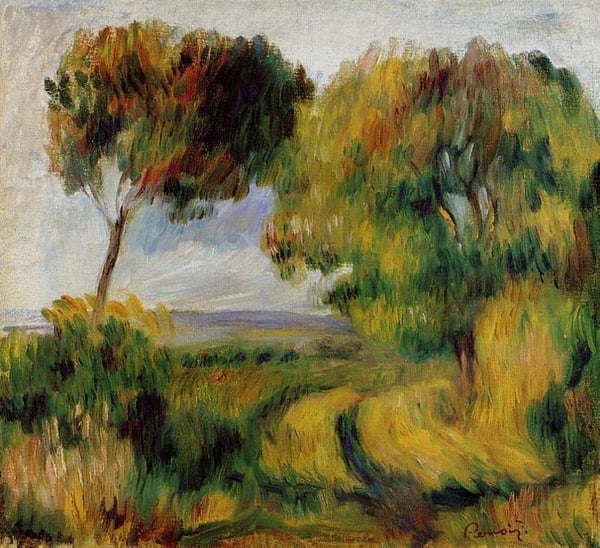
Analisi esperta di Breton Landscape Trees and Moor di Pierre-Auguste Renoir
Stile: Impressionism · Genere: landscape
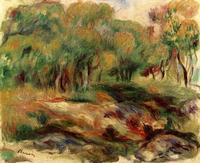
Expert Analysis: "Breton Landscape Trees and Moor" by Pierre-Auguste Renoir
Pierre-Auguste Renoir’s Breton Landscape Trees and Moor exemplifies the artist’s sustained engagement with landscape painting during his later years, a period when his style diverged from the strict optical naturalism of early Impressionism toward a more synthetic, decorative, and sensuous treatment of form and color. While Renoir is best known for his luminous figure studies and scenes of modern Parisian life, this work underscores his enduring fascination with the natural world—particularly the rugged, windswept terrain of Brittany, a region that attracted many fin-de-siècle artists for its unspoiled character.
Significance within Impressionism and Renoir’s Later Style
The painting’s significance lies in its demonstration of two key shifts: first, Renoir’s move away from the fragmented brushwork of the 1870s toward a smoother, more fluid application of paint; second, his integration of a warm, almost Venetian palette that anticipates his so-called “Ingres period” and the later nudes of the 1910s. In Breton Landscape Trees and Moor, the trees are rendered with rounded, rhythmic volumes, their trunks and foliage merging into a gentle, lyrical whole rather than dissolving into separate dabs of color. The moor—flat, open, and punctuated by patches of scrub—is handled with broad, horizontal strokes that convey the expanse and quiet melancholy of the Breton landscape.
Coloristically, Renoir balances earthy ochres, muted greens, and soft blues, avoiding the high-keyed brilliance of his earlier works in favor of a more restrained, harmonious tonal range. The sky, often a focal point in Impressionist landscapes, is treated with subdued cloud formations that echo the horizontals of the moor, creating a unified, contemplative mood. This reflects Renoir’s mature conviction that painting should not merely capture a fleeting moment of light but should also evoke a timeless, classical sense of order and beauty.
What Makes It Significant
- Transitional Quality: The work documents Renoir’s evolution from the spontaneous, atmospheric approach of Impressionism to a more structured, decorative aesthetic that foreshadows Post-Impressionist and early Modernist developments.
- Regional Identity: By choosing a Breton subject, Renoir aligns himself with contemporary movements (like the Pont-Aven school) that sought to capture the distinct character of rural France, though his treatment remains more fluid and less symbolist than Gauguin’s.
- Renoir’s Personal Maturity: Created during a period of health struggles and artistic reassessment, this landscape reveals an artist distilling his impressions into pure, tactile pleasure—what he called “the joy of painting”—even in a relatively modest outdoor scene.
In summary, Breton Landscape Trees and Moor is significant not as a radical departure but as a masterful synthesis: a late-career landscape that retains the freshness of Impressionist observation while pushing toward the monumental calm that defines Renoir’s final, most personal vision.
Museum / Gallery
Visivamente simili
20 opere con composizione e palette affini
Landscape
Xavier Martinez
Landscape
Pierre-Auguste Renoir
Landscape With Trees
Joan Brull
Brăneşti Landscape
Adam Baltatu
Sunny Landscape
Pierre-Auguste Renoir
Landscape
Pierre-Auguste Renoir
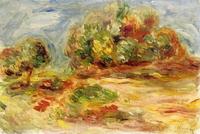
Cagnes Landscape
Pierre-Auguste Renoir
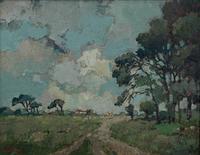
Landskap met kronkelende pad, Kenilworth
Gregoire Boonzaier
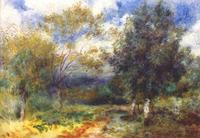
Landscape in the Sun
Pierre-Auguste Renoir
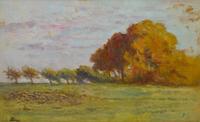
La Plaine Aux Environs De Rolleboise
Maximilien Luce
Landscape
Pierre-Auguste Renoir
French Landscape
Willard Metcalf
Landscape with Trees
Pierre-Auguste Renoir
Landscape
Pierre-Auguste Renoir
The Hedge (also known as The Clearing)
Georges Seurat
Landscape
Pierre-Auguste Renoir
Landscape
Pierre-Auguste Renoir
A Close
Paul Cezanne
Landscape
Pierre-Auguste Renoir
Olive Trees
Henri Matisse