
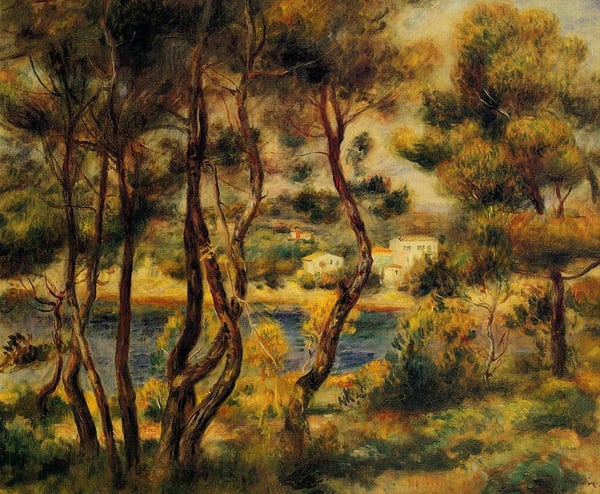
Expert analysis of Pierre-Auguste Renoir’s Cape Saint Jean
Style: Impressionism · Genre: landscape
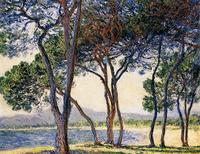
Expert Analysis: "Cape Saint Jean" (Pierre-Auguste Renoir)
Context & Significance:
Painted during Renoir’s later years, Cape Saint Jean exemplifies the artist’s mature Impressionist style, marked by a subtle departure from the pure spontaneity of his early work toward a more structured, yet still luminous, handling of landscape. This period witnessed Renoir’s increasing interest in integrating classical composition with Impressionist color and light, a balancing act that lends the scene a sense of permanence and warmth.
Visual & Stylistic Highlights:
- Landscape as essence: The Cape Saint Jean location—likely the Mediterranean coast near Cagnes-sur-Mer, where Renoir spent his final years—allowed him to explore the interplay of sun, sea, and rocky terrain. His brushwork remains feathery and broken, capturing the shimmer of light on water and the texture of coastal vegetation.
- Color orchestration: Renoir’s later palette leans toward rich, warm hues (golden earth, deep blues, soft greens) that both celebrate nature and evoke a serene, timeless quality. The use of complementary colors—orange-tinted cliffs against blue sky—enhances the vibrancy without sacrificing harmony.
- Compositional shift: While still rooted in Impressionist observation, the scene shows a firmer sense of foreground, middle ground, and deep space, reflecting Renoir’s renewed interest in formal structure. This synthesis of Impressionist light with classical stability is key to understanding his later legacy.
Why It Matters:
Cape Saint Jean is significant because it captures Renoir’s final artistic evolution—a master of Impressionism who, even as physical ailments constrained his mobility, continued to distill nature into scenes of radiant, ordered beauty. The painting stands as a testament to his lifelong devotion to capturing fleeting light while imbuing it with a sense of enduring peace.
Museum / Gallery
Visually similar
20 works with related composition and palette
Mediterranean Coastline
Algernon Talmage
Landscape
Pierre-Auguste Renoir
Juan-les-Pins
Claude Monet
The Pines of the Ile St. Morah
Maxime Maufra
Beach in Juan-les-Pins
Claude Monet
The Bay
Pierre-Auguste Renoir
The estaque
Pierre-Auguste Renoir
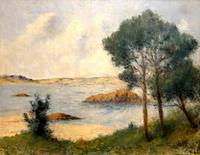
Kermouster
Maximilien Luce
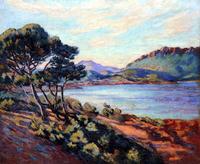
Agay Bay
Armand Guillaumin
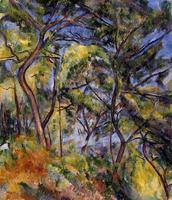
Forest
Paul Cezanne
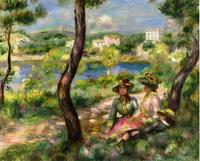
Beaulieu
Pierre-Auguste Renoir
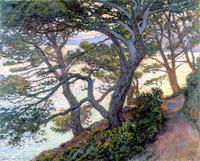
Pines of Rayol
Theo van Rysselberghe
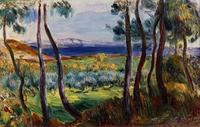
Pines in the Vicinity of Cagnes
Pierre-Auguste Renoir
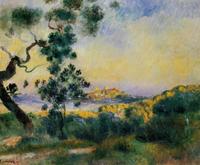
View of Antibes
Pierre-Auguste Renoir
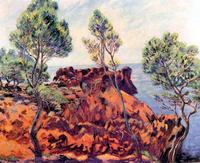
Agay, les Roches Rouges
Armand Guillaumin
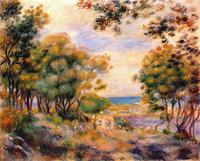
Landscape at Beaulieu
Pierre-Auguste Renoir
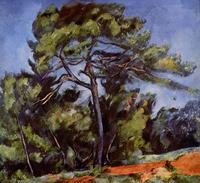
The Great Pine
Paul Cezanne
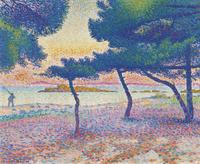
La Plage de Saint-Clair
Henri-Edmond Cross
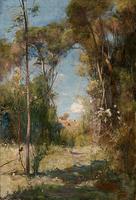
Pastoral
Arthur Streeton
Trees by the Seashore at Antibes
Claude Monet