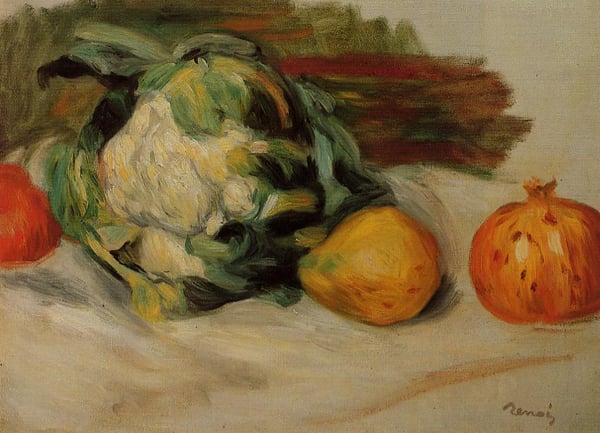
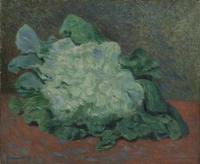
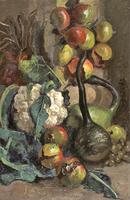
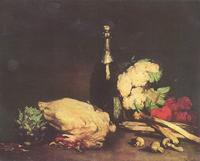
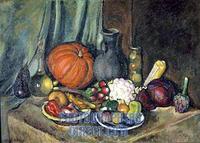
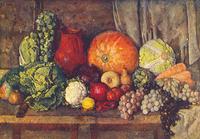
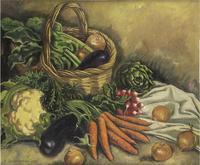
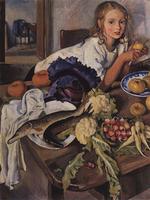
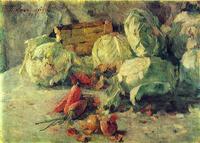
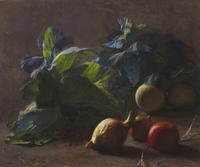
This still life, Cauliflower and Pomegranates, marks a pivotal moment in Pierre-Auguste Renoir’s career—a work created during his deliberate rejection of Impressionism. While still firmly anchored in the movement’s signature bright palette and lush brushwork, the painting signals Renoir’s turn toward more structured composition and solid, tangible forms. The cauliflower’s dense, almost sculptural white head and the rich, jewel-like pomegranates are rendered with a new emphasis on volume and weight, pushing back against Impressionism’s earlier focus on evanescent light and atmospheric dissolution. This shift, often called his “Ingres period,” sought to marry the vitality of Impressionist color with the disciplined draftsmanship of classical art. The carefully balanced arrangement—a simple yet monumental assembly of kitchen produce—becomes a laboratory for this synthesis: the loose, visible strokes still convey texture and life, but the objects feel grounded, substantial, and enduring. In this sense, Cauliflower and Pomegranates is significant as a transitional work that demonstrates Renoir’s refusal to be confined by any single doctrine, instead forging a personal, sensuous realism that would define his later output.