
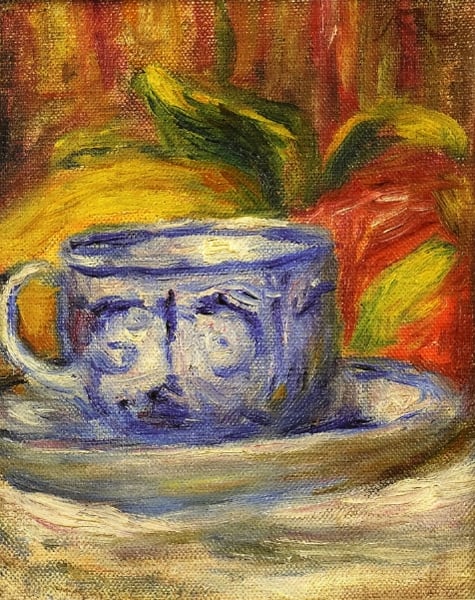
Analisi esperta di Cup and Fruit di Pierre-Auguste Renoir
Stile: Impressionism · Genere: still life
Expert Analysis of "Cup and Fruit" by Pierre-Auguste Renoir
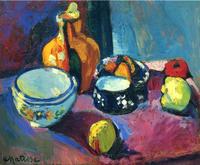
Pierre-Auguste Renoir’s Cup and Fruit is a luminous still life that exemplifies the Impressionist commitment to capturing fleeting optical sensations, even within a genre traditionally valued for its static, composed forms. While Renoir is best known for his radiant depictions of leisure and the human figure, this work reveals how he applied the movement’s core principles—broken color, visible brushwork, and an emphasis on changing light—to the intimate, everyday world of objects.
Significance within Impressionism and Renoir’s Oeuvre
-
Transforming a "Minor" Genre
Still life had long been considered a lesser genre in academic painting, subordinate to history painting and portraiture. Renoir, like his fellow Impressionists, challenged this hierarchy by treating a simple arrangement of fruit and a cup with the same vibrancy and technical ambition as a landscape or social scene. Here, the subject is not a moral allegory or a display of wealth; it is a pure celebration of sensory pleasure—the gleam of a ceramic cup, the soft fuzz of a peach, the scattered light dancing across a tablecloth. -
Impressionist Color and Brushwork
Renoir builds the composition through touches of pure, unblended color. Observe how the reds and oranges of the fruit are not flat but composed of adjacent dabs of vermilion, cadmium, and even hints of blue to suggest reflected light. The white cup is never truly white; it is modeled with pale lavender, gray-blue, and warm cream, capturing the ambient glow of the room. The sketchy, almost feathery strokes dissolve hard outlines, making the objects seem to shimmer as if viewed in a momentary blink. -
Light as the True Subject
Renoir’s still life is less about the objects themselves and more about how light transforms them. The cup’s handle catches a sharp highlight, while the fruit’s surfaces reflect both the tablecloth and each other. This focus on ephemeral effects—the sparkle of moisture on a grape, the soft shadow beneath the cup—aligns perfectly with Impressionism’s radical idea that a painting should record a fleeting visual impression, not a timeless ideal. -
A Counterpoint to Renoir’s Figurative Work
While Renoir’s Luncheon of the Boating Party or Dance at Le Moulin de la Galette are crowded with figures, Cup and Fruit strips away narrative and human presence, allowing Renoir to concentrate entirely on pure painterly values. This makes it a revealing example of his formal experimentation—his delight in texture, spatial compression, and chromatic harmony without the demands of portraiture or social commentary.
Conclusion
Cup and Fruit is significant because it demonstrates Impressionism’s revolutionary approach to all aspects of visual experience, even the most modest. Renoir elevates a humble still life into a shimmering study of optical truth, where brushstroke and color replace meticulous draftsmanship, and where the true “subject” is the transient beauty of light itself. This work stands as proof that for the Impressionists, no subject was too small to carry the weight of a new way of seeing.
Museum / Gallery
Visivamente simili
20 opere con composizione e palette affini
Cup and Oranges
Pierre-Auguste Renoir
Cup, Lemon and Tomato
Pierre-Auguste Renoir
Still Life with Lemons
Pierre-Auguste Renoir
Still Life with Fruits
Kmetty János
Sugar Bowl, Apple and Orange
Pierre-Auguste Renoir
Bela Adalbert Czobel Still Life Wit Flowers and
Bela Czobel
Czobel Still Life Gyümölcsökkel
Bela Czobel
Still Life with Yellow Plate
Kmetty János
Still Life With Green Apples
Adam Baltatu
Still Life
Pierre-Auguste Renoir
Modok Mária, Csendélet Gyümölcsel
Modok Mária
Sugar Bowl and Lemons
Pierre-Auguste Renoir
Green Quinces
Istvan Ilosvai Varga
Still Life with Fruit
Henri Matisse
Still Life
Pierre-Auguste Renoir
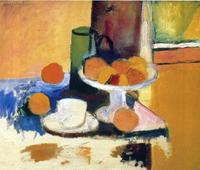
Still Life with Oranges II
Henri Matisse
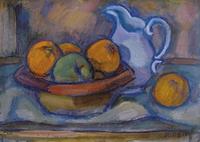
Still Life with Apples and Jug
Kmetty János
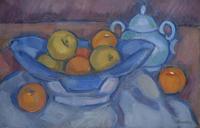
Fruits in Blue Bowl
Kmetty János
Fruits in Blue Bowl
Kmetty János
Dishes and Fruit on a Red and Black Carpet
Henri Matisse