
Expert analysis of Pierre-Auguste Renoir’s Girl in Blue
Style: Impressionism · Genre: portrait
Expert Analysis of "Girl in Blue" by Pierre-Auguste Renoir
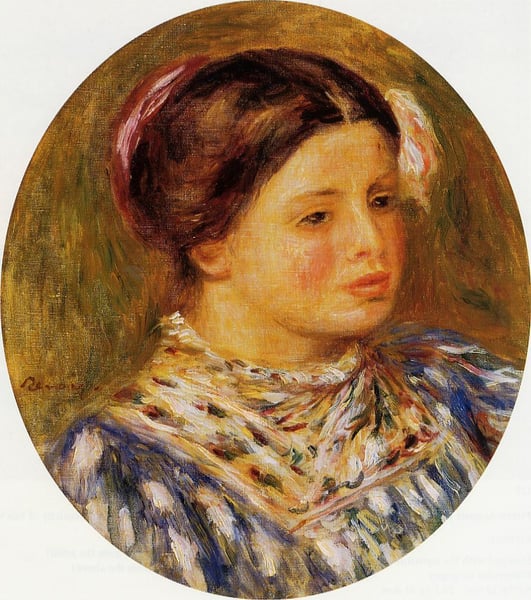
Pierre-Auguste Renoir’s Girl in Blue is a quintessential example of his mature Impressionist style, created during his Later Years (roughly the 1880s–1910s). This portrait belongs to a pivotal period when Renoir began moving away from the pure, optical concerns of early Impressionism toward a more classical, sensuous, and idealized treatment of the human figure.
Significance within Impressionism and Renoir’s Later Period:
-
Shift from Light to Substance – In his later years, Renoir’s brushwork became softer and more fluid, dissolving hard outlines into a warm, luminous haze. Girl in Blue likely showcases this: the sitter’s features are rendered with velvety strokes that emphasize volume and tactility over fleeting atmospheric effects. The rich blue of her dress—a signature Renoir hue—anchors the composition while still vibrating with adjacent warm tones.
-
The Idealized Feminine – Renoir’s late portraits often depict young women in a state of dreamy, introspective calm. Here, the “girl” is not a specific individual but a type—a symbol of youthful, rosy-cheeked allure. The blue dress, possibly with floral accents, creates a harmony of cool and warm colors that radiates a feeling of gentle intimacy, characteristic of Renoir’s desire to “paint happiness.”
-
Technical Mastery – The painting exemplifies Renoir’s later technique of using thin, overlapping glazes of color over a warm ground. This method gives the skin a soft, porcelain glow and the fabric a convincing, tactile weight. The background is typically loose and abstract, pushing the figure forward in a shallow space—a common Impressionist device that maintains focus on the sitter’s presence.
-
Legacy – Girl in Blue stands as a bridge between Impressionism’s revolutionary beginnings and the more decorative, figure-driven art of the early 20th century. Renoir’s late portraiture directly influenced later painters like Mary Cassatt and even the Nabis group, who admired his ability to fuse the ephemeral with the monumental.
In sum, Girl in Blue is significant not for radical innovation, but for its refined synthesis of Impressionist color theory, classical composure, and a deeply personal, lyrical celebration of beauty. It encapsulates Renoir’s belief that art’s highest purpose is to please the eye and comfort the soul.
Museum / Gallery
Visually similar
20 works with related composition and palette
Bust of a Young Woman
Pierre-Auguste Renoir

Girl
Vincenzo Caprile
Nini Lopez
Pierre-Auguste Renoir
Portrait of Gabrielle
Pierre-Auguste Renoir
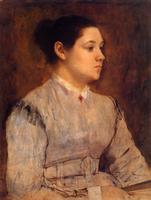
Portrait of a Young Woman
Edgar Degas

Portrait of Marie Lestringuez
Pierre-Auguste Renoir

Portrait of Elizabeth (Betsy) Fisher
William Merritt Chase
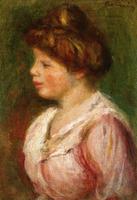
Portrait of a Young Woman
Pierre-Auguste Renoir
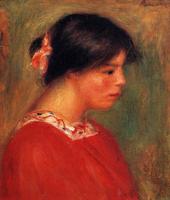
Head of a Woman in Red
Pierre-Auguste Renoir
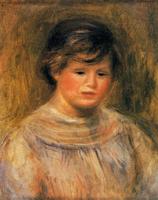
Woman`s Head
Pierre-Auguste Renoir
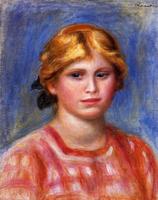
Head of a Young Girl
Pierre-Auguste Renoir

Head of a Young Girl
Mary Cassatt
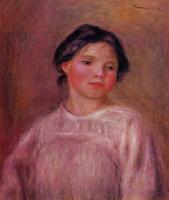
Helene Bellow
Pierre-Auguste Renoir
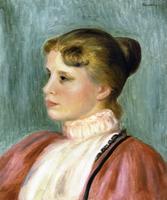
Portrait of a Woman
Pierre-Auguste Renoir
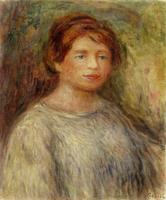
Portrait of a Woman
Pierre-Auguste Renoir
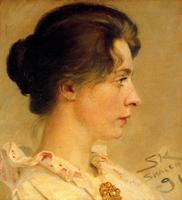
Marie in Profile
Peder Severin Kroyer
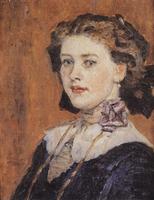
Portrait of young woman
Vasily Surikov

Madame Henriot
Pierre-Auguste Renoir
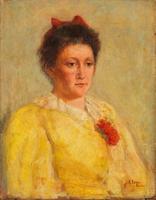
The red carnation
Silvestro Lega
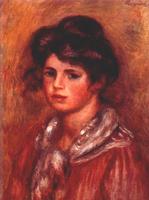
Gabrielle
Pierre-Auguste Renoir