
Expertenanalyse zu Pierre-Auguste Renoirs Head of a Girl
Stil: Impressionism · Genre: portrait
Expert Analysis of Pierre-Auguste Renoir’s Head of a Girl (Impressionist Portrait)
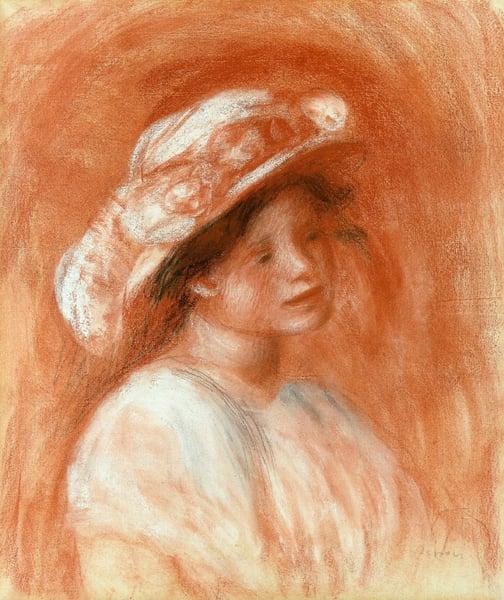
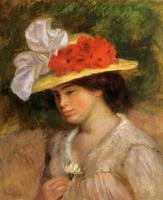
Pierre-Auguste Renoir’s Head of a Girl stands as a quintessential example of Impressionist portraiture, demonstrating the movement’s core ambition to capture the fleeting, sensory experience of a moment through light and color. Within the Impressionist canon, this work is significant for how it transforms a traditional genre—the portrait—into a study of atmospheric vibrancy and psychological immediacy.
Impressionist Technique and Color Theory
Renoir eschews sharp outlines and meticulous modeling in favor of soft, broken brushstrokes that dissolve form into patches of luminous color. The girl’s face is built from delicate touches of pinks, peaches, and creamy whites, with subtle blue and lavender shadows in the hollows of the cheeks and around the eyes. This approach—typical of Impressionism—suggests the effect of natural light on skin rather than its anatomical structure. The background is rendered in loosely applied, feathery strokes of green and blue-green, creating a sense of outdoor atmosphere even in a confined head-and-shoulders composition. The hair, a cascade of warm chestnut tones, is treated not as solid mass but as a play of light and shadow, with strands suggested by quick, directional dabs of pigment.
Significance within the Portrait Genre
Unlike formal, posed portraits of the academic tradition, Renoir’s Head of a Girl exudes spontaneity and intimacy. The subject appears caught in a candid moment—perhaps glancing aside or momentarily distracted—which aligns with the Impressionist desire to depict modern life’s unguarded instances. The warm, rosy palette and soft handling lend the girl an air of innocent vitality, a hallmark of Renoir’s portraiture that distinguishes him from other Impressionists (such as Degas or Manet) who often emphasized psychological detachment or social critique. This work exemplifies Renoir’s belief that a portrait should convey the “joy of seeing” and the inherent radiance of youth.
Context within Impressionism
Painted during the height of the Impressionist movement (circa 1870s–1880s), Head of a Girl reflects Renoir’s mature style, where he prioritizes sensory pleasure over narrative or symbolic content. The canvas’s surface remains active: visible brushwork and a lack of finish invite the viewer’s eye to blend colors optically, a technique that challenged the polished conventions of the Salon. This piece is significant as a pure expression of Impressionist ideals—light, color, fleeting sensation—while retaining the warmth and accessibility that made Renoir one of the movement’s most beloved portraitists. It demonstrates that even a seemingly simple subject—a girl’s face—could become a vehicle for revolutionary artistic innovation.
Museum / Gallery
Visuell ähnlich
20 Werke mit ähnlicher Komposition und Farbpalette
Portrait of a Woman
Pierre-Auguste Renoir
Bust of a Young Girl in a Straw Hat
Pierre-Auguste Renoir
Young Girl Wearing a Red Hat
Pierre-Auguste Renoir
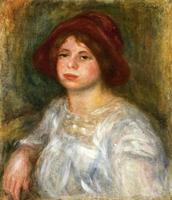
Girl in a Red Hat
Pierre-Auguste Renoir
Woman in a Straw Hat
Pierre-Auguste Renoir
Profile of a Young Woman in a Hat
Pierre-Auguste Renoir
Amelie Dieterie in a White Hat
Pierre-Auguste Renoir
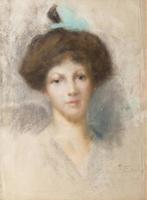
Portrait of a woman
Pompeo Mariani
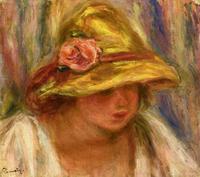
Study of a Woman in a Yellow Hat
Pierre-Auguste Renoir
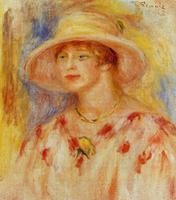
Lydia Sieligmann
Pierre-Auguste Renoir
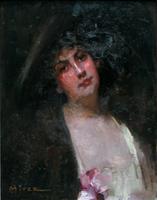
Princess Aristizza Ghyka
George Demetrescu Mirea
Young Woman Wearing a Hat
Pierre-Auguste Renoir
Young Girl in a Blue Corset
Pierre-Auguste Renoir
Woman in a Straw Hat
Pierre-Auguste Renoir
Portrait of a Young Woman
Pierre-Auguste Renoir
Portrait of Mrs. Pataki
Jozsef Rippl-Ronai
Girl
Joan Brull
Gabrielle in a Chemise
Pierre-Auguste Renoir
Bust of a Young Woman in a Red Blouse
Pierre-Auguste Renoir
Woman in a Flowered Hat
Pierre-Auguste Renoir