
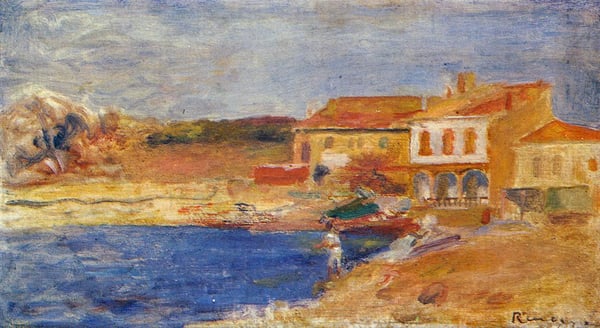
Expertenanalyse zu Pierre-Auguste Renoirs Houses by the Sea
Stil: Impressionism · Genre: cityscape
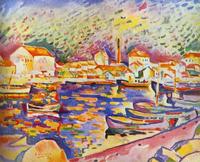
Expert Analysis of "Houses by the Sea" by Pierre-Auguste Renoir
-
Style & Period Context: Executed during Renoir’s later years, this work exemplifies the mature phase of Impressionism. While the artist initially helped define the movement’s focus on transient light and broken color, his later output – often termed his "classical" or "pearly" period – shows a shift toward warmer, more luminous palettes and a softer, almost hazy handling of form. "Houses by the Sea" retains Impressionism’s hallmark spontaneity and plein-air freshness, yet it also reveals Renoir’s deepening interest in structure and harmony, a synthesis that distinguishes his late style.
-
Genre & Subject: As a cityscape, the painting captures the intersection of human habitation and the natural coastal environment. Renoir does not render architectural details with precision; instead, he conveys the impression of houses nestled along the shore – their roofs, facades, and reflections dissolving into dappled light. This approach transforms a mundane seaside town into a shimmering vision of color and atmosphere, typical of Impressionism’s goal to record the sensory experience of a moment.
-
Significance within His Oeuvre: The work is significant because it demonstrates Renoir’s lifelong commitment to depicting the pleasures of modern life even as his technique evolved. In his later years, Renoir often retreated to the South of France, where the intense Mediterranean light inspired him to use even more vibrant, saturated hues. "Houses by the Sea" likely reflects this shift: the sky and water glow with a rich, near-orange warmth, while the houses are built from flecks of pure pigment that vibrate against one another. This mastery of optical mixing – where the viewer’s eye blends the colors – reinforces the Impressionist ideal of capturing light as it directly affects the retina.
-
Art Historical Importance: For students of Impressionism, this painting illustrates how Renoir balanced the movement’s radical break from academic tradition with a personal, decorative sense of beauty. It shows that later Impressionist works did not simply repeat earlier formulas; they refined the technique, moving toward a more timeless, idealized vision of nature – one that would eventually influence Post-Impressionists and early modernists. In "Houses by the Sea", the loose brushwork and celebratory palette remain thoroughly Impressionist, yet the scene feels more serene and composed than, say, Renoir’s earlier, busier Parisian street scenes. This maturity makes the piece a key example of how Impressionism evolved from a radical movement into a classic expression of light and joy.
Museum / Gallery
Visuell ähnlich
20 Werke mit ähnlicher Komposition und Farbpalette
Seascape Near Marseille (Fantastic Village)
Adolphe Joseph Thomas Monticelli
Houses in Mangalia
Stefan Dimitrescu
Port Alguer
Salvador Dali
Port of Cassis
Adolphe Joseph Thomas Monticelli
Venetian Landscape
Odilon Redon
Springtime at the Sea
Matej Sternen
Landscape
Salvador Dali
Peisaj la Cassis
Jean Alexandru Steriadi
Cassis Landscape
Lucian Grigorescu
Cagnes Landscape
Pierre-Auguste Renoir
Seascape
Paul Cezanne
Landscape from Balcic
Nicolae Darascu
The Harbour at St. Jean Cap Ferrat
Winston Churchill
View of Portdogue (Port Aluger)
Salvador Dali
Houses in Bretania
Adam Baltatu
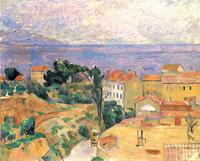
View of L'Estaque
Paul Cezanne
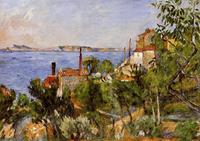
Landscape. Study after Nature
Paul Cezanne
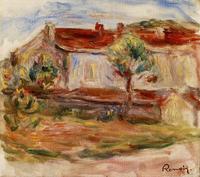
White House
Pierre-Auguste Renoir
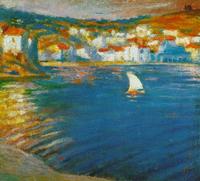
Landscape Near Cadaques
Salvador Dali
The Estaque
Georges Braque