
Expert analysis of Pierre-Auguste Renoir’s In the Garden
Style: Impressionism · Genre: genre painting
Expert Analysis of "In the Garden" by Pierre-Auguste Renoir
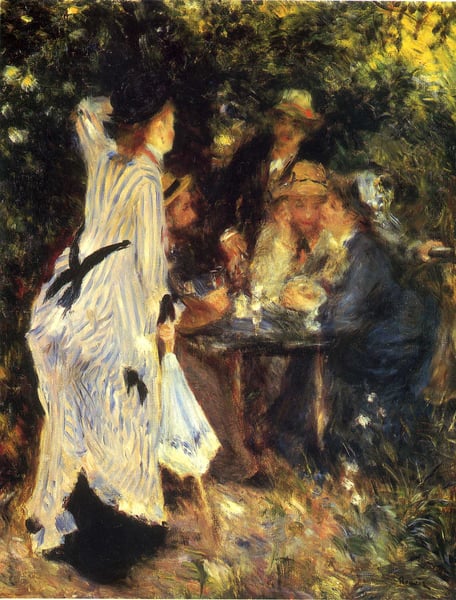
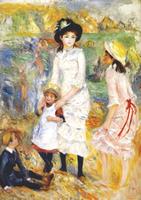
As an Impressionist genre painting, Pierre-Auguste Renoir's "In the Garden" captures a quintessential moment of modern leisure that defined the movement’s break from academic tradition. The work exemplifies Renoir’s lifelong fascination with the interplay of natural light, vibrant color, and human intimacy, elevating an ordinary domestic scene into a celebration of sensory pleasure.
Stylistic Significance
Renoir’s signature feathery brushwork and luminous palette are on full display. Dappled sunlight filters through foliage, dissolving the boundaries between figures and their environment—a hallmark of Impressionist technique. Instead of crisp outlines, he uses broken, rapid strokes of pure color (pinks, greens, golds) that blend optically, evoking the transient effects of outdoor light. This approach prioritizes the visual impression over detailed realism, making the garden feel alive and shimmering.
Subject Matter as Modern Life
The work belongs to the genre of scènes de la vie moderne—scenes of contemporary life. Renoir often painted friends, family, or models in relaxed, informal poses. Here, figures (likely a mother and child, or lovers) are absorbed in quiet conversation or reading, embodying the bourgeois leisure that Impressionists championed. The garden is not a mythological or historical setting but a private, sun-drenched space accessible to the modern Parisian—a direct challenge to the lofty subjects favored by the Salon.
Significance Within Impressionism
"In the Garden" reflects Renoir’s unique contribution: his ability to infuse everyday moments with warmth and joy. While Monet focused on atmospheric effects and Degas on psychological tension, Renoir celebrated human connection. The painting’s loose composition—figures cropped and placed off-center—suggests a candid snapshot, aligning with the Impressionist desire to capture the fleeting, unposed present. Its soft, affectionate treatment of light and skin tones also foreshadows Renoir’s later, more bucolic works of the 1880s, solidifying his reputation as a painter of happiness.
Conclusion
"In the Garden" is significant not only as a masterful display of Impressionist technique but also as a testament to Renoir’s belief that art should be “pleasing, beautiful, and full of sunshine.” It transforms a simple garden scene into a radiant, timeless vision of harmony—a key reason why Renoir remains one of the most beloved figures of the movement.
Genre
Style
Visually similar
20 works with related composition and palette
In the Bois de Boulogne
Berthe Morisot
In the Garden
Pierre-Auguste Renoir
The Cup of Tea
Pierre-Auguste Renoir
On the Terrace at Sèvres
Marie Bracquemond
Croquet
Edouard Manet
Lunch on the Grass (central panel)
Claude Monet
The End of Lunch
Pierre-Auguste Renoir
Figures in a Park, Paris
William James Glackens
The Luncheon of the Boating Party
Pierre-Auguste Renoir
Café de la Paix
William James Glackens
Morning Sunshine
Karoly Ferenczy
In the Orchard
Edmund Charles Tarbell
Study for 'A summer morning'
Rupert Bunny
Beneath the Lilac at Maurecourt
Berthe Morisot
On the terrace
Pierre-Auguste Renoir
At the Cafe
Pierre-Auguste Renoir
Le Déjeuner sur l'herbe
Claude Monet
Trio fleuri
Jan Toorop
The Apple Seller
Pierre-Auguste Renoir
Children on the seashore
Pierre-Auguste Renoir