
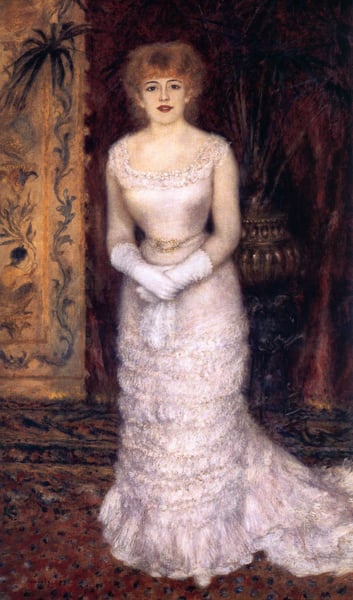
Expert analysis of Pierre-Auguste Renoir’s Jeanne Samary
Style: Impressionism · Genre: portrait
This analysis focuses on the significance of Pierre-Auguste Renoir’s Jeanne Samary within the context of Impressionism and its period.
Artwork: Jeanne Samary (c. 1877)
Artist: Pierre-Auguste Renoir
Style: Impressionism
Genre: Portrait
Period: Association with Impressionists
As an Impressionist portrait, Jeanne Samary is significant for its radical departure from traditional formal portraiture. Rather than seeking idealized, static likeness, Renoir captures the vibrant, fleeting essence of a real, modern woman. The subject—a celebrated jeune première at the Comédie-Française—is not posed stiffly but appears relaxed, almost caught mid-gesture, embodying the Impressionist fascination with contemporary life and spontaneous moments.
Renoir’s signature use of flickering, feathery brushstrokes and a luminous, warm palette (dominated by rose, gold, and creamy whites) transforms the canvas into a shimmering surface of light. The background is dissolved into soft, unfocused tones, pushing the figure forward while denying any rigid spatial depth—a hallmark of Impressionist technique. Her dress, with its diaphanous ruffles, becomes a cascade of broken color, and her skin glows with pink highlights that suggest both the intimacy of interior light and the artist’s sensitivity to flesh tones.
The portrait’s significance also lies in its celebration of the modern Parisian woman as a subject worthy of high art. By painting an actress—a public, professional figure—Renoir elevates the ephemeral, performative world of the theater to the same level as aristocratic or bourgeois commissions. Jeanne Samary is portrayed not as a distant muse but as a vivacious, intelligent individual, her direct gaze engaging the viewer with an air of confidence and charm.
Within the Impressionist movement, this work stands as a perfect synthesis of the group’s core aims: capturing the optical impression of a moment, emphasizing the effects of natural (and interior) light, and depicting a slice of modern life with a sense of immediacy and joy. Renoir’s soft, sensuous handling—neither caricature nor photographic realism—became a defining model for the Impressionist portrait, influencing how personality and atmosphere could be conveyed through color and brushwork rather than meticulous detail.
Museum / Gallery
Visually similar
20 works with related composition and palette
Ms. Helen Dixon
William Merritt Chase
Portrait of Princess Evelyne Colonna di Stigliano
Vittorio Corcos
Portrait
Francis Day
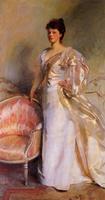
Mrs George Swinton
John Singer Sargent
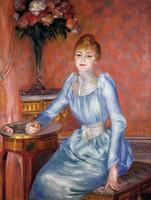
Madame Robert de Bonnieres
Pierre-Auguste Renoir
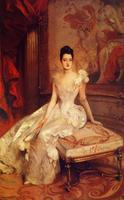
Mrs. Hamilton McKown Twombly (Florence Adele Vanderbilt)
John Singer Sargent
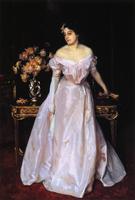
Hylda, Daughter of Asher and Mrs. Wertheimer
John Singer Sargent
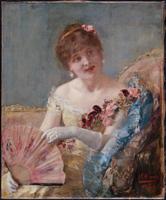
Woman with fan (Portrait of Réjane?)
Henri Gervex

Young Beauty In A White Dress
Julius LeBlanc Stewart
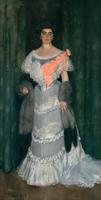
Montserrat Casas de Nieto, in Evening Dress
Ramon Casas
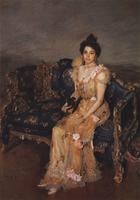
Portrait of Sofia Mikhailovna Botkina
Valentin Serov
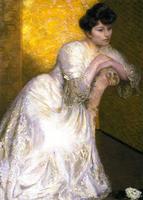
The Yellow Screen
Lilla Cabot Perry
Young girl in a ball gown
Berthe Morisot
Lady in an Evening Dress
Lilla Cabot Perry
Madame Leon Clapisson (Marie Henriette Valentine Billet)
Pierre-Auguste Renoir
The Yellow Screen
Lilla Cabot Perry
Portrait of Countess Anna De Noailles, Princess of Brancovan
Antonio de La Gándara
Mrs. Leeds, the later Princess Anastasia of Greece (and Denmark)
Giovanni Boldini
Portrait of the Countess of Clary Aldringen
John Singer Sargent
Preparing For The Ball
Alfred Stevens