
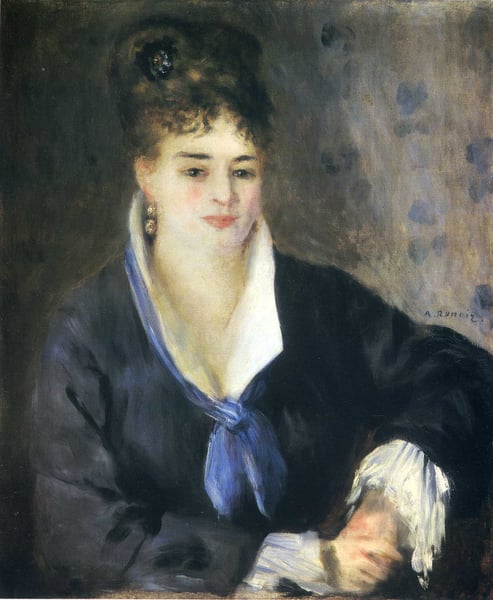
Expertenanalyse zu Pierre-Auguste Renoirs Lady in a Black Dress
Stil: Impressionism · Genre: portrait
Pierre-Auguste Renoir’s "Lady in a Black Dress" is a striking portrait that encapsulates the core ambitions of Impressionism while pushing beyond the movement’s typical preoccupation with light and color. Painted during Renoir’s association with the Impressionists, the work is significant for demonstrating how the artist adapted Impressionist techniques to the traditional genre of portraiture—achieving both modern spontaneity and timeless elegance.
Technical and Stylistic Significance
At first glance, the black dress poses a challenge for an Impressionist painter, who normally relied on bright, broken color to capture the play of light. Renoir solves this by treating black not as an absence of color, but as a living, responsive hue. He layers subtle blues, violets, and deep greens into the fabric, allowing the viewer to sense the ambient light of the room and the sheen of the material. The brushwork is characteristically loose and feathery on the dress, while the sitter’s face is rendered with greater precision—a hallmark of Renoir’s portraits, which balanced the Impressionist “snapshot” effect with psychological depth.
Themes of Modernity and Femininity
The lady’s direct gaze and relaxed posture reflect the modern woman of late 19th-century Paris—confident, fashionable, yet intimate. The stark contrast between the black dress and her pale skin draws immediate attention to her expression and personality, rather than to costume alone. This aligns with Impressionism’s interest in capturing contemporary life, but also reveals Renoir’s particular genius for making portraiture feel both candid and refined.
Placement within Renoir’s Oeuvre
While many of Renoir’s most famous works (like Dance at Le Moulin de la Galette or Luncheon of the Boating Party) are crowded social scenes, Lady in a Black Dress exemplifies his mastery of the single-figure portrait. It shows that Impressionism could handle the somber, elegant side of modern life, not just its sunlit pleasures. The work stands as a testament to Renoir’s ability to translate the fleeting effects of light into a permanent, dignified image—making it a significant example of how Impressionism reshaped the portrait tradition.
Museum / Gallery
Visuell ähnlich
20 Werke mit ähnlicher Komposition und Farbpalette
Portrait of Suzanne Manet
Edouard Manet
Unknown
Jules Bastien-Lepage
Madame Claude Monet
Pierre-Auguste Renoir
Portrait of a lady with a black fichu
Edouard Manet
Artemis Gyzi
Nikolaos Gyzis
Miss Frances Sherborne Ridley Watts
John Singer Sargent
Female Portrait
Konstantin Makovsky
Woman with a rose
Pierre-Auguste Renoir
Violet
John Singer Sargent
Vernon Lee
John Singer Sargent

Portrait of Madame Felicie Vellay Estruc
Camille Pissarro
A Young Woman
Pierre-Auguste Renoir
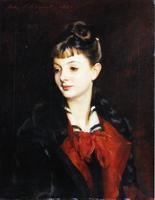
Portrait of Mademoiselle Suzanne Poirson
John Singer Sargent
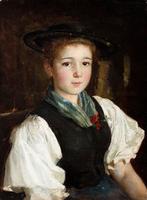
Portrait of a girl
Albrecht Anker
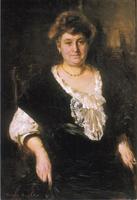
Portrait of Mrs. Bormioli
Amedeo Bocchi
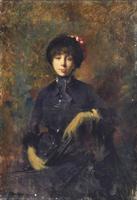
Portrait of the wife of the painter Rossano
Giuseppe De Nittis
Portrait of Dona Elena Ortúzar
Joaquín Sorolla
Portrait of Marie Jeanne Liotard with a basket of peaches
Jean-Étienne Liotard
Portrait of Nini
Camille Pissarro
Female Portrait
Konstantin Makovsky