
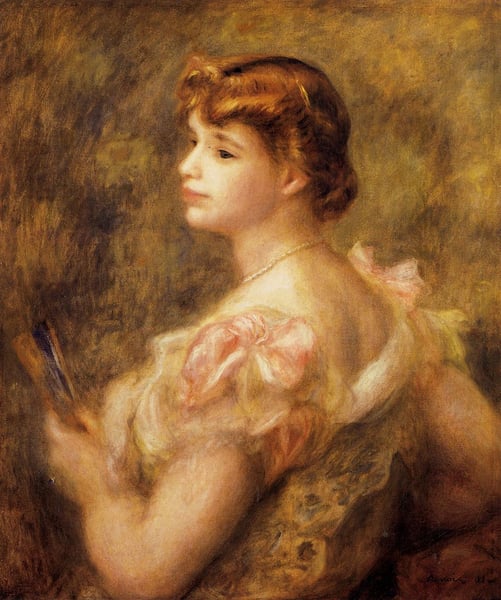
Analisi esperta di Madame Charles Fray di Pierre-Auguste Renoir
Stile: Impressionism · Genere: portrait
Expert Analysis: "Madame Charles Fray" by Pierre-Auguste Renoir
Style: Impressionism | Genre: Portrait | Period: Later Years
In his later years, Pierre-Auguste Renoir retreated from the ephemeral, broken brushwork of early Impressionism, moving toward a more classical, structured approach without abandoning the movement’s core devotion to light and color. “Madame Charles Fray” (painted circa 1890s–1900s) exemplifies this mature synthesis: a portrait that balances the immediacy of Impressionist atmosphere with a renewed emphasis on form, volume, and psychological depth.
What Makes This Work Significant
-
Renoir’s Shift to “Dry” or “Classical” Impressionism
During his later period—often called his “période sèche” (dry period)—Renoir adopted a tighter, more linear style, influenced by Raphael and Ingres after a trip to Italy in the 1880s. “Madame Charles Fray” demonstrates this evolution: the sitter’s face and hands are modeled with soft, rounded contours, while the background and costume dissolve into feathery, warm strokes. This dual approach—sculptural solidity in the figure, atmospheric flux in the setting—makes the portrait feel both enduring and fleeting. -
Intimate Bourgeois Portraiture
The subject, Madame Charles Fray (likely the wife of a wealthy patron or friend), is shown in a three-quarter pose, her gaze calm and direct. Renoir does not flatter with idealized features; instead, he captures the specific texture of her skin, the sheen of her hair, and the quiet dignity of her expression. In an era of grand society portraits, Renoir’s emphasis on gentle realism—the slight flush of her cheeks, the soft fall of light on her shoulder—brings an unprecedented sense of private life to the genre. -
Color as Emotional Atmosphere
Renoir’s palette had grown richer and more resonant by this stage. Here, he uses a restrained harmony of rosy pinks, creamy whites, and muted blues—a color scheme that conveys both warmth and sophistication. The background is deliberately vague, composed of dappled, opalescent tones that suggest a floral wallpaper or garden. This dissolution of background into pure light is a hallmark of Impressionism, yet Renoir controls it carefully so that the figure remains the anchor. The result: a portrait that breathes, rather than simply poses. -
Mastery of Textures
Renoir’s later technique is celebrated for its tactile quality. In “Madame Charles Fray,” he renders the fabric of her dress with short, broken strokes that catch light—lace appears almost transparent, velvet feels dense—while the skin is built from thin, layered glazes. This ability to simulate different surfaces with paint (not just the illusion of them) connects the work to the Impressionist fascination with perception.
Place in Renoir’s Oeuvre
This portrait stands as a bridge between Renoir’s Impressionist roots and his late, monumental nudes. It demonstrates that, for Renoir, portraiture was not merely a commission but a study of humanity bathed in light. “Madame Charles Fray” is significant because it shows an artist at the peak of his technical powers, integrating the lessons of Impressionism with a timeless, classical respect for the subject. It remains a quiet masterpiece—neither as famous as Luncheon of the Boating Party nor as daring as his late bathers, but perhaps more intimate and revealing of Renoir’s belief that painting should capture “the soul of things.”
Museum / Gallery
Visivamente simili
20 opere con composizione e palette affini
Portrait of Kornélia Lotz
Károly Lotz
Portrait of a Young Woman
Pierre-Auguste Renoir
Mary Turner Austin
John Singer Sargent
Head of the Girl
Konstantin Makovsky
Portrait of the Hon. Emily Mary Lamb
Thomas Lawrence
Portrait of a Young Girl
Alexei Harlamoff
Female Portrait
Franz Stuck
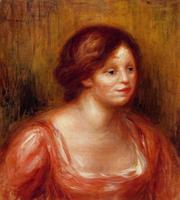
Bust of a Woman in a Red Blouse
Pierre-Auguste Renoir
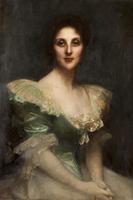
Portrait of Fanny Thérèse Reinach
Pascal Dagnan-Bouveret
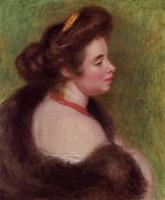
Madame Maurice Denis nee Jeanne Boudot
Pierre-Auguste Renoir

Portrait of Blonde
Konstantin Makovsky
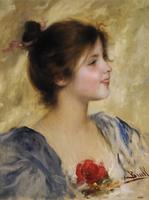
Portrait of a girl
Joan Brull
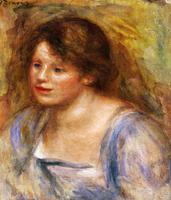
Portrait of Lucienne
Pierre-Auguste Renoir
Portrait
Konstantin Makovsky

Head
Konstantin Makovsky
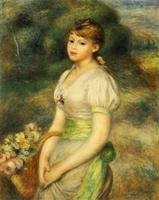
Young Girl with a Basket of Flowers
Pierre-Auguste Renoir
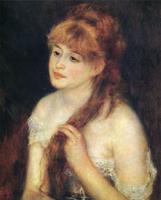
Young Woman Braiding Her Hair
Pierre-Auguste Renoir
Woman with a Fan
Pierre-Auguste Renoir
Adele besson
Pierre-Auguste Renoir
Woman Wearing a Corset
Pierre-Auguste Renoir